Actively Engaging Media

Actively Engaging Media

I’ll never understand people who don’t read. That’s not true. I’ll never understand people who passively ingest media. Thems the kind that just let the TV happen at ’em.

You’ve probably heard it said a good writer is a great reader. It’s an alright adage, despite having been repeated to the point of redundancy–and with good reason. Because whatever mechanism that drives human ambition is blind to the amount of work that goes into a piece of working literature. You may keep meeting the people that want to write a book who don’t read any books. You may keep running into people who call themselves writers who don’t actually produce anything. But if you meet a writer who does produce and doesn’t read? I don’t know, write their teachers from high school and inform them how much of a disappointment their students have become. The point is that this writing schtick takes work and that work primarily consists of reading a butt load. If you don’t like reading, then, Jesus, dude I don’t know why you’re here. But if you’ve been putting reading books on the backburner, remind yourself that it’s as much work as it is play and crack that sucker open.

So rejoice, all ye wordsmiths, for yer work be entertaining and usually pretty fun. Reading is a good time and don’t forget to enjoy it. But lets take it a step further. I’ve mentioned a couple of times on this blog about the worth of analyzing films and video games.  I want to ruminate a little further on that, such that that in addition to becoming great readers, we also become great purveyors of art of all kinds. So maybe don’t take off your writing lenses when you treat yourself to a Netflix binge or video game marathon.

The good news is that you were probably going to watch movies and television shows anyway. The challenge is sussing out a lesson in works that exist for us to disappear into– and feel free to become absorbed into a film, that means the storytellers are doing something right. It’s up to you, however, to figure out why it was so effective in ensnaring your attention.

We’re all brothers and sisters in this world of storytelling and there’s a lot to be learned from analyzing other mediums. Think critically of how a film is shot–think of the technical nightmare it takes to pull off a scene like this. This is important to pay attention to because, to dust off another overused adage, “Writing is like directing a movie in someone else’s mind.”

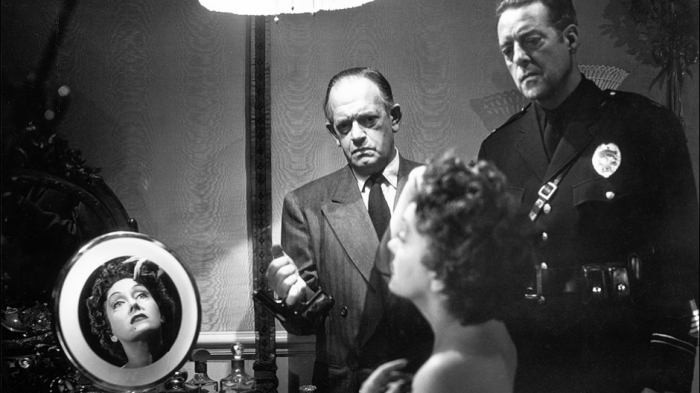
Think about how a single frame can tell a story by its composition:
paramount_940x529_v220-20banner_28
Sunset Boulevard (1950)


By this screen grab alone, you see evidence of Norma’s vanity (the mirror), her break from reality (as she’s not even looking at herself, or the police in the mirror but somewhere far away) . You understand the severity of the situation– there’s been a murder (gun being held as evidence) and Norma’s suspect (police. duh.). And as far as tone goes? An unsettling clash of dark darks and bright lights.

How would you write this scene in a book? How would you write it in a short story? A poem? A song? You’d write it differently for each, I’m sure, because you aren’t half-assing this. Do you get a different feeling from the writing? How so? What details are you leaving in? Out? Why? What changes? Asking ourselves a lot of questions helps to understand the choices being made in other’s work and asking the same question of our own work leads to bigger realizations and (ideally) a clearer focus of what we’re trying to achieve.

So we’re paying attention now, effectively “reading” all forms of art. But where to start? What does a balanced media diet look like? You already know what you like to read, right? Start there and keep at it. And if you find yourself merely entertained and reamin unchallenged, hit up a booklist and maybe pick up one or two of those the next time you’re strolling past your book store. Film? How many of IMDB’s top 250 have you viewed?  Read analyses of film, film, video games. (Hell, I watch hour long videos summarizing Final Fantasy plot lines, because I remember being moved by them as a kid and want to identify the successful elements those stories hit upon.) Read The AV Club after your favorite episode of whatever airs and get your brain juices flowing.

We live in an age when criticism outnumbers content 1000:1 and there’s a lot of content out there. Identifying the useful, educational criticism should help cultivate storytelling instincts and give you the tools and vocabulary to dissect your own stories and see what’s working and what is not.

Read. Watch. Listen. Read.

And don’t forget to write.

Unveiling the Illusion: Noir Nerdin’

Unveiling the Illusion: Noir Nerdin’

Spoiler alert up top: I’m going to delve into Chinatown, LA Confidential and True Detective. If you have any interest in being surprised by those works, you might want to stop reading now.

I’ve heard it around the way that a successful Sci Fi or Fantasy book reveals its built up world gradually through the fresh eyes of the main protagonist. I got to thinking that maybe noir does the same thing, except in reverse– we’re introduced to a fantasy and then what follows is the revelation of our very own dark and gritty universe (usually) through the eyes of the protagonist who can see the true, underlying reality.

In my post on character sketching, I quoted Raymond Chandler’s bit on Phillip Marlowe. The relevant piece is this:

The story is this man’s adventure in search of a hidden truth

That’s not breaking any minds to tell you that The Detective archetype is searching for some veritas in noir detective fiction. But I want to pause first on why these guys feel the need to pursue that hidden truth, or rather, what makes them the type of character that knows something is there.

Sherlock Holmes is a good place to start. He solves crimes by deductive/inductive reasoning. He looks at something from above and in the solving of the case, elevates the crime to his own level. He’s simply smarter than the crime.

But noir heroes slum along the bottom. The Noir Detective yanks down the case to his level. Because his world is the truthful one and the illusion spun by the conspiracy of his social betters doesn’t sit well with the reasoning of the cynical world.

In the first season of True Detective, Rust Cohle has been through the hell of losing a child and living deep undercover for years, well acquainting him with the pain of living and how the criminal world operates. When he transitions into a homicide detective, he’s aware that the structures in place are illusory– he can sniff corruption on his fellow police and the investigation is being misdirected by an invisible hand. Cohle also extends this to the broader subject of the world:

“It’s all one ghetto, man, giant gutter in outer space.”

Rust works outside of the agreed upon societal norms, because he outright rejects them as an illusion. He rejects authority, he rejects human relationships, he rejects society. Which is what makes his and Marty Hart’s relationship so powerful– Marty is discovering that his suburban American dream is ultimately immaterial, realized in the bitter disintegration of his marriage and the troubling sexual pressures his daughters encounter. And he’s ultimately powerless to stop it (owing to his own sexual infidelities, alcoholism, and heavy handed parenting methods). It’s only when Marty is dragged to the bottom, to the world of harsh truths where Cohle is waiting for him, that they are able to finally solve the murders.

The mechanism of noir is the progression of interviews and interrogations. In there lies the fabric of the illusion– everyone provides deceitful information to obfuscate the truth. Let’s take a look at Chinatown in which Jake Gittes (a veteran of the harsh realities in Chinatown) is approached by Evelyn Mulwray who turns out to a be an actor. The water department covers its tracks of diverting irrigation to the orange groves. Hollis Mulwray is found drowned in freshwater, but had salt water in his lungs. Katherine Mulwray is supposedly Hollis’s mistress, before it’s revealed that she is Evelyn’s sister before [redacted]. Everything seems to be positioned in such a way that it seems normal at first glance. By the end of the film, every threaded lie is unspun and what remains is a sinister and grim reality dressed up as a caper. In other words, it’s still Chinatown where base crimes are the norm and it turns out that the rest of LA is no different. Again, normalcy is the fantasy.

Also, how good is it that Gittes gets his nose sliced up, metaphorically making him an impotent detective coinciding with him unable to decipher the pageantry in front of him? Pretty sweet.

There’s a lot to play with here and a good example of flipping this script is James Elroy’s LA Quartet. If you think about the main characters driving the novels, they are actually somewhat naive and too obsessed with outperforming their peers to realize the fallacy the of the criminal justice system they participate in. Perhaps because of this, they are often casualties of their own investigations, one way or another. Meanwhile, the common thread through all of these stories is the ever terrifying Dudley Smith, a man who understands the dark reality of crime and departmental (even federal) corruption. Instead of being a The Noir Hero, he chooses to perpetuate (and occasionally even create) the illusion to benefit himself financially and further his career. I can’t think of a better noir villain than Dudley.

At the end of the day what you have is a character interacting with the setting. Interacting is the operating word. I feel as if many books in various genres offer a passive protagonist who allows the world to happen at them. What I appreciate about noir is that the protagonist digs his hands into the guts of the setting and shows the reader its entrails and shouts, “THIS! THIS IS WHAT WE’RE MADE OF.”

Perhaps there’s a lesson in that for all of us.


If you’re a fan of noir mysteries, perhaps try my hardboiled detective novel, Muddy Sunset. It follows PI Roy DeLon through the streets of St. Louis 1955 as he untangles a web of MS_cover_smallcorporate deceit, murder, and treason. You know, casual stuff. It’s available in paperback and kindle formats here.