Enterprises of Great Pith and Moment, Fear and Loathing

Enterprises of Great Pith and Moment, Fear and Loathing

Disappointment alert: there’s not anything here about Hunter S. Thompson.

“Brevity is the soul of wit,” says Polonius, an ironically longwinded gasbag in Hamlet. But he’s got a point. Clever turns of phrase are measured in their pithiness. A lot can be crammed in a single sentence. The infamous “To be, or not to be” phrase that appears in Hamlet has staying power because in five simple words the audience is asked a probing, disturbing question: Is existence better than nonexistence?

Last time we discussed implicit stories by maintaining control of narrative information. This time, let’s get into the implicit stories told by individual lines.

For there to be a story weighted to a phrase, there needs to an implied question– which in turn implies an underlining conflict. You know who understands this very well? Advertisers. Sometimes they give you the answer to the question first, like a slimy Alex Trebek. Then you figure out the question and complete the story on a subconscious level:

Just Do It.

The question in your head is something like “will I or won’t I?” with the underlying conflict being a testament of courage. It becomes “Am I brave enough to do it?” And then this shoe tells you to go for it.

I’m Loving It.

The presupposed question is “DO YOU LIKE THIS HAMBURGER, HUMAN?” And you love it.

Some advertisers just give you the question and have you answer it. But they do it in a shitty way. It’s not, “What would you do for a Klondike bar?” its “What would YOU do for a Klondike bar,” asking you to plumb your depths and find the most appealing depraved act you could possibly stomach for a freezer-candy. “What’s in YOUR wallet.” Etc.

It’s effective marketing because it puts you into the story. Moving on.

The phrase “I do,” summons an entire scene specific to your own history of witnessing weddings, even if you’ve never been to one. The phrase “I didn’t” should probably conjure up a specific memory of shifting the blame to someone else when you broke that vase as a kid. Point is, the less information you provide, the more the reader fills in.

Now. There’s the urban legend of Hemingway’s six word novel. Supposedly (*cough*falsely*cough*), Ernest penned the following in exchange for zeroing out his bar tab:

For sale: baby shoes, never worn.

The implicit story is clear: that The Beatles got the idea to smoke pot from Bob Dy–haha, just kidding, a baby’s dead and an impoverished parent is reduced to selling the shoes. It’s tragic and concise. It tells a complete story. It’s not a novel.

The distinction of a novel is defined somewhat arbitrarily by word count– Starting around ~40,000 – ~50,000 words. I supposed you would call the baby shoe thing flash fiction. I’m not really going to argue whether or not flash fiction has merit– we’ve already gone into the power of short, implicit phrases– but I do want this to come around to long-form story telling, because the baby shoe “novel” feels kind of cheap and exploitive of the reader’s emotions.

So, flash fiction is fun and also kind of bullshit. I like Twitter. I also get bored reading Twitter. You know why pop music is grating? It’s just a bunch of hooks jammed together. A meal is not a bunch of appetizers. A bone without meat on it is only good for making broth–I’M GETTING OFF MESSAGE.

Listen.

“To be, or not to be,” is fantastic in its divine simplicity. But despite how you might remember it, there’s more to the soliloquy, which not only further explores the merits of suicide and keepin’ on keepin’ on (as the bard puts it) but it also turns to the question of action. Is it better to act, or be idle? Hamlet kills Polonius a few scenes later, answering his question. (“Dead for a ducat.” Killing is easy, cheap.)

We remember the short, key phrases as a mental shortcut to the story. But they’d be worthless without the rest of the poetry in Hamlet. Imagine how disappointing the play would be if it was simply a guy yelling a single line per scene. It’d be two minutes long and while surely a greater story is implied, it’d be insubstantial garbage, no better than corporate advertising.

Don’t get me wrong, I want you to write the densest, most meaningful, most pregnantest lines possible. Give me pause or give me death! It’s just easy to forsake substance for style. And without substance, there’s no new challenge to the reader.

I’m still figuring this out. But I’ve noticed that there’s a methodical application of where to put your darlings for maximum effect:

  1. The hook for the scene (“To be, or not to be…)
  2. When accompanying an action (“Dead for a ducat…”)
  3. When closing a scene, or when a character exits (“To a nunnery, go”)

That last one’s got some stank on it.

Effectively, these encapsulate the idea and concept of the “meat” while also relaying questions for the audience to fill in (is life worth living; is death meaningful; is that not some cold-ass shit to say to your fiancé?).

Or you could give up and write poetry.
Black Box: The Art of Restraint

Black Box: The Art of Restraint

There’s a concept in illustration called artistic restraint– at least, that’s what I call it. It’s knowing when to stop adding texture and detail before you over-complicate the image and make it harder for the eye to engage with it. The idea is that the viewer will fill in the missing pieces subconsciously. The full image is implied by the artist’s “incomplete” rendering.

This applies to fiction and I’m not talking about brevity, either. I’m talking about the pacing of information, because in a lot of ways, the best examples are those that are technically “overly-complete,” in its exposition, while burying the lead– the grander narrative, so to speak– under layers of storytelling .

The classic example of this is Hemingway’s “Hills Like White Elephants,” wherein a couple has an intense conversation without ever directly acknowledging the subject of debate. One of my professors once told me that this story was a failure, in that no one understood what the story was actually about until Hemingway gave it away in an interview. I kind of agree to an extent (anyone who tells you what that story is about was 99% likely to have been told themselves. It’s not exactly evident in the writing.) but I also appreciate that all readers understand that something bigger is going on in this little exchange.

Easier discussed examples are found in the horror genre. I’ve mentioned before that H.P. Lovecraft loves to obfuscate the true horrors of his stories with psychosis, doubt, and scientific reasoning, while only allowing a mere, vague glimpse of the monster before the story ends. His contemporaries, such as John Carpenter, do likewise– you never see what the Thing actually looks like, just the perversion of its replicated host. The doubt and conflict is born out of the fact that anybody could be the Thing.

A modern novel that understands informational control well is Bird Box by Josh Malerman. The premise is this: there are “somethings” floating around outside and if you see one of them, you go insane and kill yourself and those around you. The entire book is therefor written, essentially, blind whenever the characters are not inside of a boarded up house– which also creates a sense of blindness to the outside world, despite the sensory details of a home. The amount of information as to what the hell is happening is minimal, and experienced minimally. As such, there’s a pervading sense of paranoia and claustrophobia throughout the entire book, expressed through these sensory limitations. Also, the climax contains one of the most appalling things that has ever entered my brain.

It Follows takes this concept and makes it one of its primary themes. The horror is only experienced by the protagonist as they’re the only person who can see the monster in pursuit. Furthermore, it’s relevant only to their life, taking on the image of someone they know personally. Essentially, the cursed person’s experience of the horror is filled in by their own subconscious– generally with the broad strokes of Freudian of sexual formation (Jay first sees an elderly naked woman, possibly her grandmother; Greg sees his own mom in a night gown; Hugh claims to see a girl in a yellow dress). The horror experienced is a black box that no other character can access. What’s excellent about It Follows is that it spends just as much time with its secondary characters, usually slasher-fodder, and actually develops them into a unit of friends concerned about the protagonist undergoing a difficult time that they don’t understand– because they don’t have the information that the protagonist has. As much as you sympathize with the main character’s isolation, because you’ve been there, you also empathize with the others’, because you’ve been there today.

Information becomes currency in stories. Look at Silence of the Lambs and pay attention to what information does. The main storyline unfolds like a procedural tracking down Buffalo Bill until Hannibal Lector comes onto the scene. He understands that information is powerful. He delivers information about Jame Gumb to thread the narrative along for what? Information about Clarice Starling. Specifically, personal, traumatizing information about Clarice Starling’s childhood. Quid quo pro. It does something to a reader, having to face a character’s darkest memories. The reader, along with Clarice, has to access their own personal account of darkness and attach the weight of their own traumas to hers. But the character of Hannibal Lector does something even more insidious– he gets the reader to goddamn like him. You do what Crawford always warned Clarice about: you forget what he is. So when he finally bursts out of his cell via the grisliest means necessary, you’re suddenly stuck between cheering him on and personal betrayal accompanied with self-disgust.

It’s called a psychological thriller for a reason.

The thing that you carry away isn’t necessarily the way that the story ends, but how it affected you. Silence of the Lambs is effective because it’s main plot line is almost a red herring for the more subtle horror of Lector accessing Starling’s/your mind. Buffalo Bill is disturbing. Hannibal Lector is seductive. Silence does this by foiling Lector with Crawford, both manipulative men. The story controls its flow of information so carefully, that while you, along with Starling, are wary of Crawford who remains stoic, vague and unyielding of his intentions, you buy into Lector, who’s smart, polite and generous with his knowledge. It makes Starling, and you by extension, despite everything in her power to remain at the head of the curve, naive. 

The Black Mirror episodes, “Shut Up and Dance” and “White Bear” execute this perfectly by stringing along an increasingly cruel set of circumstances for the main character, encouraging our sympathy the entire time, before dropping the curtain and revealing who the main characters really are–a simple revelation that makes us question whether or not our sympathy was deserved. It puts the entire narrative we were just told into another light with a single line of information. That’s the power of limited perspective.

In the batshit crazy House of Leaves the information we are given is… a lot to take in. The worst but only way I can describe it: this is a book about a guy who’s writing about a book he found written by a different guy about a film a third guy made about his house that doesn’t make sense. And that’s just scratching the surface.  I think I’ve mentioned before that reading this book in public makes you look crazy– you have to turn it around to read all of the annotations, flipping through several pages, back and forth, as there are annotations to annotations, forcing you to reference the index in the back and you journey through the narrative only to find that it folds into itself endlessly. And then, if you’ve done the homework, solved the puzzles, educated yourself about architecture, documentary film-making, and cryptology… the real story emerges like a 3D painting.

And it happens weeks later after finishing the fucking thing. It’s a study in forming broad strokes via intricate design.

I know what you’re thinking: how does this relate to True Detective? Funny you should ask because I was just about to go there, you pidgeon-toed, gawking ratfink. Hardboiled noir fiction runs on the engine of gathering information about a crime or infidelity. Usually this is done with a progression of interviews, voyeurism, and clever deceits. Like all stories, it becomes complex and then it simplifies. Which you have in True Detective, expressed as a buddy cop procedural. Within that basic structure, you have the narrative device of flashbacks, contextual to the interviews of Cohle and Hart. It’s a simple thing to point out, but the fact that you see these guys as ruined, possibly insane old men makes you wonder what exactly the hell happened 18 years ago to warrant these changes.


True Detective also plays out as a horror story. There’s an encompassing feeling of dread threaded throughout the miniseries. But it’s only glanced at as reverberations in the “psychosphere,” mentioned by junkies, felt but never seen– the closest we come to seeing it is Cohle’s hallucination of the black star while he’s being choked out by Errol. Usually we see it in brief glimpses through Marty’s eyes– his daughter’s recreating a ritualistic murder scene with dolls, or the entropy of of a tasseled tiara stuck in a tree. Likewise, the protagonists never face the shadow society responsible for the historical murders in the area. They get Errol– which disappointed a lot of viewers but is thematically on point. Sticking with concrete leads brings them to a concrete, yet impotent conclusion and Cohle understands that the bigger, elusive (and allusive) culprits are still at large. Hart acknowledges their own limit of understanding by the consolation “We got our guy.” The story becomes complex in its information and then it simplifies, but the difference here is that there is still incomplete, complex, deliberately placed information that hasn’t been digested by the narrative, speaking of a much larger conspiracy that appears unconquerable.

All of this is to say that the most effective story you can tell is one that subtly asks the reader to tell themselves a story along with you. They’ll meet you halfway.


All the World’s A Page

All the World’s A Page

During the office hours for a medieval literature class, my professor (and in case it wasn’t clear that I was a poor, poor academic, I was taking this class remedially, as I had flunked out of that same professor’s Chaucer class) told me something I’ve been turning around in my head ever since– that people in the Dark Ages read the world allegorically.

What the hell does that mean? Well, first you need to consider that folks in the olden days didn’t read words so much. Literacy was a tool reserved for Jesus nerds (clergymen) who would read, and then interpret, the Bible during mass. To be a good Christian, one has to read the Bible faithfully. So how does an illiterate farmer accomplish that?

According to my professor, a farmer dude might look at a tree and contemplate it as an allegory for Christ. He’d see the roots planted firmly in the ground, the branches leaning into the sun, and I don’t know, he’d see an apple or something. And he’d interpret that to mean by firmly grounding oneself in faith (roots), seeking truth in the God’s word (light, sun), one is rewarded (fruit, salvation).

And then he’d go stick some leeches on his butt because a barber told him that cured syph’.

Basically, the gist of it is that they saw the world as a manifestation of The Bible, that the world had the Word of God coded into its every corner.

It’s a common misconception that people in history were dumb. We have a tendency to think because we’re progressively marching towards a fairer world and have smart phones, that we’re smarter than we used to be. We’re not, exactly. Our phones are. The human brain hasn’t changed much in thousands of years (except the relatively modern trend of shrinkage). The farmer doesn’t have the tools of literacy, or a socially aware history, or access to modern medical science. We stand on the shoulders of giants.

But what I think that story speaks to is that farmer still had a critically thinking brain, and he applied it to the world around him using the lens of religion to understand and interpret that world.

Despite all of our technology, despite the lowest global illiteracy rates we’ve ever seen, I’m beginning to think that we still read the world allegorically. You’d think that it’d be the other way around– that we view something, we interpret it, and then we write our piece on it. And maybe that’s true some of the time and probably definitely true in early development. But I’m thinking that maybe our brains become wired to hold certain schemas (primed by upbringing, advantages or disadvantages, and media) about how the world works such that we interpret events before they happen– or rather, we justify events to fit our preexisting schemas.

Children do this naturally and intentionally– I personally crafted my life to reflect a reality of Calvin and Hobbes, pretended to be a pirate after watching Hook, and I would fight hundreds of invisible foes after watching 3 Ninjas. That’s until I discovered video games, after which, I made swords and shields out of errant pieces of metal lying around my house. I threw Pokéballs at bugs. I’d watch the ocean, hoping to see a dragon. I wanted these things to be real to the point that I was willing to let my imagination redirect reality into a personal narrative. At least until playtime was over.

Writers have a tendency to do this in adolescence in a very meta sense– writing fan-fiction using pre-existing fantastical universes to access their own emotions and frame their own internal struggles with something familiar. (Uncomfortable example: “Oh nooo,” said Professor Umbridge. “It seems I’ve dropped my quill.”) 

Now we live in an age of information bubbles, where two polarized sides of America can watch the same news story play out and offer two completely disparate interpretations, each one validated by their home base.

How does that happen? Well, we’re all aware of the concept of confirmation bias, right? That you only seek out the information that serves your views and ignore or discredit that which opposes your views. That’s the psychological mechanic behind reading the world allegorically. It’s just that The Bible we’re priming ourselves with now includes literature, movies, the news, memes and social media. Our brains understand the world around us through what we watch and read and consume on a daily basis.

Astrology is a good example of this in action. Let’s say you’re a Libra and are interested in dating a Leo (Hey, I’m a Leo! It doesn’t matter.) because you know and love Leos. You two go out for a drink. Despite this Leo being generally uptight and reserved, you might find yourself ignoring this and focusing on what makes them appear to be gregarious and outspoken. (“They laughed at my joke! Leos love jokes! This is going to work!” or “They were such an asshole to the bartender! Classic Leo! This is going to work!”)

Or maybe your Horoscope informed you that you would find someone who had been missing from your life and advised to stay away from tenuous situations. Then a friend from high school wanders into your workplace and orders a coffee (you’re a barista in this example, because, of course you are). Later, a dispute breaks out between coworkers and you choose to separate yourself from it. You get home and remember your horoscope, and wouldn’t you know it, it came true! Didn’t it?

Well, these are examples of shoehorning a paradigm into something benign– or in the dating example, a special kind of color blindness that sees all flags as white. Not to get into too much of a tangent on the cookie-cutter advice Horoscope writers dish out (not that it’s ever bad, per se, but it’s just common sense. Avoid tenuous situations? One of the reasons human beings are still alive is our capacity for risk assessment), but wouldn’t it have also been true if you read, say, a Cancer’s ‘scope and it said something like, “You will reclaim a memory you thought you had lost and cool heads prevail under times of duress?”

When it matters, it’s when the situation isn’t so benign. Look at it from a political perspective, because apparently it’s impossible not to these days.

On the right: If your news, your friends and family, your Mark Wahlburg movies and favored political leaders are saying that Islam is a religion of war, you’re going to look at the world, afraid, and find examples to justify that fear– because examples of violence are there, and the natural tendency is to extend that example to all examples. But you’d be ignoring the 99.994% of the global Muslim population who aren’t extremists and the 94% of terroristic attacks carried out on US soil by non-Islamic extremists because that doesn’t fit the narrative.

On the left: If your news, your friends, perhaps not your parents, your comedians and favored political leaders vilify red state voters, you’re going to find examples of white supremacy, misogyny, and hate– because examples are definitely there. But you’d be ignoring the plight of former industrial workers who can’t get a job because governmental interests have left their economy to rot and their towns are in the valley of too populous yet too small to accommodate customer service jobs like cities and suburbs can. They chose the devil they didn’t know, because the last one screwed them in their perspective.

Obviously, I fall onto the left side of the spectrum. But I want everyone to recognize that our minds, beautiful machines capable of astounding works that they may be, are reactionary to precedent information which perhaps interprets the world for us, before we can even take a moment to breathe.

Psychological schemas are solid, but not unshakeable blueprints. We’re constantly updating (usually buttressing) the designs, but never lose hope that the most hateful of people can come around to a reasonable understanding as long as we remember that people are people and have always been people.

The only thing I can think to prescribe is a careful and well variegated media diet. I’m not saying you should listen to Alex Jones– I’m pretty sure no one should– but perhaps by entertaining– not necessarily believing or ascribing to– a palette of perspectives, we can understand each other’s personal allegory. Because our brains will favor a story over reality every single time.

Failing that, remember what Socrates said: “I do not think I know what I do not know.


Reading Media Narratives

Reading Media Narratives

Disclaimer: I’m ignorant about a lot things. Here’s the things I’ll admit to: I dropped political science in college, not because I didn’t find it interesting but because I never showed up to the Friday discussions of International Politics. (This would be why I also failed The Philosophy of Love and Sex. Oops.)  I dropped the journalism major because I failed Economics 101. (A writer who’s irresponsible with money? What kind of monkey shine is this?) I’ve also never made a quiche and don’t want to know how.

But I’m trying to understand how narrative works. We all know the basic structure, right? You have a beginning, a middle, and an end. You know what recent political slogan also shares those qualities? “Make America Great Again.” It presupposes that America was once great, it’s currently not, and will be great once more because of us. Simple. Unifying. Four words, even. It doesn’t track as well with “I’m with her,” which is inherently divisive, because if you’re not with her, you’re against her, a message cemented by the “deplorables” gaff. Hillary Clinton’s response to MAGA was “America is already great,” which is probably better stated as “America’s better than it’s ever been, statistically,” as the former doesn’t contain a story, just an ending– which apparently translated to half the country as no change.

Political and media narratives generally don’t share this three act structure– they are always written in the middle of things, without time to contextualize history or put a neatly wrapped bow on top of it. That happens after the fact, when history is canonized. These stories are written now.

It’s interesting to see it from a fiction writer’s perspective. Because we know, or are struggling to realize, that every story has a different set of triplets embedded within each of their narrative wombs. Every story has a Hero, a Villain, and (oftentimes forgotten) a Victim.

That might be why the most enduring religious (and political, it its own way) narrative of western culture is of Jesus Christ. Not only is there a Beginning (Bethlehem, three kings, shiny star, manger), a Middle (proselytizing, gathering disciples, miracles, crucifixion) and an End (resurrection, Heaven, legacy of Christianity) but the HVV trinity is also soundly in place: There’s a Hero (Jesus), a Villain (Original sin, or Satan, or Rome), and a Victim (the poor, the sick, the lame, the oppressed). This parabola and narrative conflict has been carefully crafted over centuries of canonization.

Ok. The most maligned and divisive phrase you’re going to hear for the next four years is “That’s how Trump got elected.” Without adding to that garbage fire of vitriol, I’m going to try and extrapolate Trump’s campaign message using the HVV dynamic, while also adding, in political narratives, no one will ever claim to be the villain, while claiming to be the victim is viewed as politically weak.

Trump’s campaign universe had all three characters in a neat package:

The Hero (Himself, tremendously), the Villain (The corrupt, backstabbing government insiders), and the Victim (The working class people who feel their diminishing industries have been forgotten).

Versus Clinton’s:

The Hero(es) (Clinton, women everywhere), the Villain (Trump), and The Victim (…)

That last box is left a little blank, although there were many possibilities to fill it– Trump bragged about sexually assaulting women, claimed Mexican immigrants were rapists, that Muslims were dangerous, that stop and frisk policies aren’t biased against POC, that prisoners of war were losers, you name a demographic, he– in no uncertain terms– victimized them.

Which ended up as footnotes in the debates, if brought up at all. We saw play out a game of intense political chess. Politically, she can’t shift women over from the Hero slot to the Victim role (whereas Trump, somehow, did by bringing out the women that claimed Bill Clinton had sexually harassed). Her immigration stance was relatively soft and seen as hypocritical in the shadow of Obama’s mass deportations, while any discussion about Muslims was either deferred to the Middle East as America’s Eyes and Ears, or avoided in an effort to escape the goddamn Benghazi trials. When BLM was brought up, specifically when police brutality in black communities was addressed, Clinton went for the nuanced approach that we’re all a bit racist (statistically true) opposed to Trump’s proclamation of Law and Order— because she probably would’ve backed herself in a corner taking a more aggressive approach due to her Super Predator comments.

Sidenote: Clinton’s verbiage is interesting to me because it’s similar to how I instinctively write certain scenes: Exposition, Dialogue, Exposition, EXTREME LANGUAGE CONTRARY TO THE PREVIOUS EXPOSITION TO INDICATE A SHIFT IN VALUE, Expository endcap. It’s clear that Hillary Clinton is a reader. Trump’s language is interesting to me because it’s entirely made of extreme language, in short, obscene outbursts. Kind of like LA Confidential.

Where was I? Clinton’s Victim eluded.

She let the Villain speak for himself, which to be fair, seemed like a reasonable thing to do. To her credit, Clinton appears to be a very sensible person and believed that voters would see through Trump’s narrative (and over 3 million more people did, but we’re not going into that right now), but, in retrospect, by not allowing Trump to speak for himself, he gained a firmer grasp of that narrative with a broader platform and doubled down.

Let’s get away from the election. It’s over. It was disheartening, divisive and an ugly cartoon. And it’s over.

So let’s move on to how the media, now that it’s not encumbered by the election, is now encumbered by DJ Trump’s Presidency.

Again, these narratives exist in the middle, always, and also contain the three character structure of Hero, Villain, and Victim.

On the left, this time, the Victims take the center stage because there are so many people legitimately effected by the rapid-fire executive actions of the last two weeks: Women seeking healthcare at NGO’s outside of the US, Muslims from 7 specific non-terroristic countries, Green card holders, members of the LGBTQ community, Native communities that don’t want their water poisoned, Californians who subsist on nothing but avocados, peaceful protestors, federally funded science programs, lower class individuals who can’t afford healthcare, and a hell of a lot more that I can’t remember because of the executive order blitzkrieg (the violent flurry of which might be a political strategy in and of itself– like a missile released with chaff to distract enemy fire).

The villains are obvious: Trump himself, Steve Bannon, Jeff Sessions, Betsy DeVos, Sean Spicer, it goes on. The Heroes come and go. Sometimes it’s Bernie, sometimes it’s Elizabeth Warren, but as of yet no solid figure has emerged.

In conservative media circles, it takes a little detective work to figure out the moving parts. The Hero is still Trump because he’s following through with his campaign promises. The Villain role has shifted directly to Muslims, immigrants, the companies and states that oppose the muslim ban, and leftist protestors. The Victim, this time, are harassed police and business owners.

That’s if the Victim is pointed out at all. Using the Victim role while in a seat of power is generally unwise. But there’s usually an implicit Victim and it took me forever to figure it out because it’s also a misdirection. Check out this Tweet:

screen-shot-2017-01-30-at-9-13-11-am

In a discussion that didn’t include Veterans at all, this tweet focuses its empathy towards that demographic because without a Victim, the story isn’t complete. Sometimes you have to force it. Like when Kellyanne Conway invents a massacre to justify the traveling ban. Or #Pizzagate. Or like this:

bloodtwitter

Dick Spencer is carefully assuming the role in an to attempt to make his white supremacist movement appear sympathetic and oppressed– going so far as Alt-Righters (otherwise known as nazis) goad liberals into punching them at protests. They want that video to go viral because it confirms their notion that liberals are a hypocritically violent and ironically intolerant. In other words, it villainizes liberals.

I figure it’s important to practice deconstructing media narratives now, because not only is there a good chance that the White House press corps will be primarily Breitbart affiliates within a couple of months, but also if you want to have a perspective changing dialogue, it’s key to identify which characters are in their narrative. If you can’t understand their ideology, you can at least understand their story.

So when informing yourself on current events, regardless of your political views, ask yourself the following questions:

Who’s the Hero, Villain, and (most importantly) Victim? 

Why are they portrayed this way?

Where does this story fall into the broader narrative being told?

Good luck out there.

Out of Frame

Out of Frame

I got into an argument with my favorite bartender recently about the genius of Baz Lurhmann. His argument was Moulin Rouge. My counterpoint was The Great Gatsby.

Ahem.

Baz Lurhmann’s The Great Gatsby is heartwarming tale of how a writer-director can take what is arguably the most American novel of all time and transform it to a staggering monument of cinematic piss. At 2 hours and 23 minutes, the film is a bloated psychedelic music video that is bookended by the frame narrative of Nick Carraway writing the book while being treated for alcoholism in a sanatorium.

While certain critics will defend this retcon as an innovative insight into F. Scot Fitzgerald’s life, which indeed spiraled into alcoholic chaos, it’s important to note that Fitzgerald wrote Gatsby in Europe, relatively comfortably, and that it was, in fact, Zelda Sayre who actually wrote a book while in psychiatric care.

You could say the use of the frame narrative device is similar to that of the cinematic adaptation of Naked Lunch, but that argument does not hold an ounce of water (or… gin?)–the film Naked Lunch is a schizophrenic journey of pornographic, junkie appetites that desperately needed narrative grounding, whereas The Great Gatsby is already a complete narrative, rendering any additional storytelling device unnecessary.

It’s kind of frustrating when you read Luhrmann thoughts on his own direction:

“What scenes are absolutely fundamental to the story? What scenes must be in our film? And what scenes can we do with out, even if we love them?”

Luhrmann isn’t really known for discipline in his movies. And that’s fine. He’s about spectacle and I can respect that. But when you pair the above quote with the one below, from the same interview, my mind explodes:

“in the novel, Fitzgerald very deftly alludes to the fact that Nick is writing a book about Jay Gatsby in the book […] – “Reading over what I have written so far…” So Craig and I were looking for a way that we could show, rather than just have disembodied voiceover throughout the whole film, show Nick actually dealing with the writing[…]”

That’s a wide reach to justify the choice of framing the narrative in the film. If I had to guess, Baz either wrote (or directed) his way into a corner, and the focus on Nick Carraway was his solution. I respect that writing involves a lot of creative solutions for the problems you give yourself and a frame narrative might actually be helpful. I’ll even say that the subdued shots of a novel being organized was some of my favorite imagery used in the film, because I’m a gigantic dweeb.

But I’ll take this explanation to task as the Nick storyline is the very definition of visual “telling” and not showing. It’s making literal what was initially implied. Many book adaptations mention that the narrator wrote the book that you hold in your hands– without having to wedge apocryphal material in to justify it.

And if you want an example of perfectly adapting a narrator into a film, look no further than Netflix’s A Series of Unfortunate Events. Which proves that it’s doable without coming off as heavy-handed.

But maybe I’m bitter because when I watched Gatsby in 2013, I left the theater angry because the novel I was working on at the time began with a frame narrative taking place in a psychiatric hospital. When I saw the trope play out on screen, it came off as cheap and melodramatic. I changed it immediately as soon as I got home.

Why did it come off as cheap? How did the device actually change the story?

In Gatsby, the frame device put a lot of weight on the story itself– that’s what a frame narrative does, looking back to a time with a different perspective– and shifts the perspective of the interior story away from a ruminative reflection on the foibles of greed, the emptiness of shallow relationships, the tedious culture of high society and the meaninglessness of achieving the American dream through ill-gotten gains to a brooding, traumatized perspective that undercuts the significance of anything else.


But in the end, The Great Gatsby (2013) got 48% on Rotten Tomatoes, which is a score a high school English teacher would give a book report presentation if it was just Baz Luhrmann nodding along silently as a Jay-Z album played through.

Then again, Robert Redford’s 1973 Gatsby vehicle got 39%. The one in 1949 has a score of 38%.

Maybe we should just leave Gatsby alone.


Star Wars – The Art of Derivation

Star Wars – The Art of Derivation

I watched Rogue One in theaters with my family on Christmas day. I walked away from the experience pretty satisfied, albeit disturbed by the creepy CGI characters. Also, I would’ve been completely hammered if I had made a drinking game out of how many times the word “Hope” is uttered.

Overall it was a fine time. I enjoyed it more than The Force Awakens which is, by all accounts, a perfectly OK film. I think I know why.

All art is derivative. Our best films make no apologies about it (*cough*Tarantino*cough*GuyRitchieRiffingOffTarantino*cough*). Star Wars is notable for ripping the bones straight out of Flash Gordon— and in fact, the entire universe was built around George Lucas not being able to acquire the rights to make that film. What’s more, is the influence from Akira Kurosawa– if Flash Gordon was the bones, The Hidden Fortress provided the meat, fleshing out the style and action sequences of A New Hope. (Lucas also snaked Kurosawa’s infamous side-wipe technique with great effect).

So when The Force Awakens came to theaters, there was one major criticism that pointed out a flaw that couldn’t be ignored. (Hint: it’s the second biggest criticism of Return of The Jedi) The major gripe was that it was essentially A New Hope’s skeleton wearing a Millenial-friendly skin. It makes perfect sense that the screenwriters would do this, to pass the Star Wars brand along from the beloved Original Trilogy to the scrappy newcomers, but after replicating A New Hope beat for beat it still had to introduce a whole new cast of characters creating way too many plot points to give each a decent amount of screen time. As a result, the actual plot of the movie feels almost inconsequential, given that the movie doesn’t even end when the Dea—er, Starkiller Base explodes.

Which isn’t to say that it’s a bad movie. But when the derivative content comes from the same series, it becomes self-referential and when the self references become the primary leg the film stands on, it’s easy for it to teeter towards a redundant, unrewarding viewing experience. (To use a musical corollary, the best hip hop samples outside of its genre, even its own medium).

Narratively, this also cheats the script out of valuable time to accommodate the threads of the story. For all of the various problems that plagued Episode One: The Phantom Menace (shitty kid, poor direction, JJ Binks) perhaps the biggest sin was trying to telegraph too much story in the allotted time of a standard movie. I’ve linked to a lot of videos in this post, but if you watch only one video, make it this one, which shows George Lucas and his team’s reaction to the first screening of Menace. Before he starts to justify it, he looks truly remorseful for shoving too much at once, the same way how I was remorseful last night, shoving both pizza and buffalo wings in my mouth at the same time. (You thought I was going to make a sexual joke right there. Shame on you.) Lucas’s film editor has the best feedback: juggling four scenes at once convolutes the story. Whereas all three films in the Orig’ Trig’ only had to juggle three. (Eg: Empire is cleanly split between Luke’s training, Han and Leia’s shiznoz, and Empire business before it all comes together.)

While Rogue One clearly had references to the other movies, most of these were background easter eggs for nerds to gush about online. (I had a moment myself when I saw a probe droid flutter in the background) Because that’s the Star Wars brand. But the wisest decision this film made is that it sought to derive it’s content from other sources. First, the vibe is more Raiders of The Lost Ark in its first act, with the Arabic architecture, crowded streets, and obligatory show downs. Second, and most notably, Rogue One takes not only a page but an entire iconic character out of Japanese cinema and drops him in the universe. I’m referring to Zatoichi, The Blind Swordsman. Zatoichi is basically Japan’s Bond franchise, featured in 26 films between 1962 to 1989, a television series, and a Beat Takeshi revival.

By going back to the Samurai influence, Rogue One succeeded in creating a standout character that the audience could attach to easily, as his predecessor had cleared the way for immediate familiarity– Chirrut Imwe, a blind warrior connected to the force, but not quite a Jedi, and probably your favorite character of the film.

It might seem exploitative to take a character that’s essentially been screen tested over seas for years but after exporting Transformers and Marvel blockbusters overseas for the last two decades, to the point that their studios are beginning to mimic our brainless cash cows, it’s nice to see tried and true foreign influence in American cinema again.

Read and watch broadly, folks. Fold variegated influences into your work and resist the urge to hit the same beat for every song, movie or story.

True Crime: An American Love Story with Real Life Noir

True Crime: An American Love Story with Real Life Noir

We live in an age of an unprecedented fascination with true crime. While I’m not obsessed, per se, I myself hold an interest in the macabre, listen to The Last Podcast on the Left religiously and regularly weird people out with my burgeoning encyclopedic knowledge of serial killers. It’s healthy. And hey, My Favorite Murder found a surprisingly large audience and ranks #22 in top podcasts as of this article’s posting. Serial still dominates the top 10 in most charts, and its good season came out over two years ago. So why the sudden wave of True Crime Entertainment? Is it that the proliferation of podcasts in the last 10 years have offered a medium to accommodate previously verboten, niche subjects? Is it because the subject has been embraced specifically by alternative comedians, making the content more easily digestible? (Comedy is 75% horror, remember?)

Yeah, probably. But that doesn’t account for the years of CSI episodes based on real crimes, or Forensic Files, or etcetera.

So maybe I misspoke earlier. I think there is a precedent.

Millenials are a generation who grew up with the OJ Simpson trial and Columbine on TV. That was the media circus that crept into our minds at an early age, when we were just trying to scam candy dollars off our parents and play Super Smash Brothers. (You could also make the case that the OJ fracas revitalized and cemented interest in The Legal Thriller, but never mind that now). How could we not be curious about this stuff when we grew up, when we were raised in an exploitive media environment that leads with whatever’s bleeding?

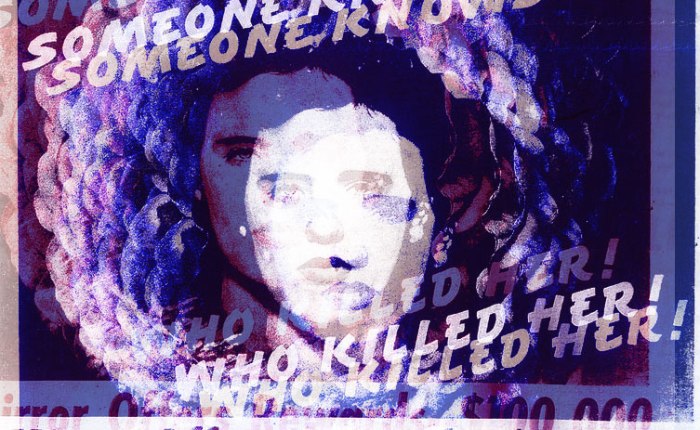
That’s a piece of the puzzle, but news media has been exploitative since the invention of ink. Sensationalism surrounding serial killers was already a thing, so what happened in the late 80s that reinvigorated the interest?  Other than a slew of scary murders? I guess I should say, what came out in the 80s that made murder marketable? I look at the fact that James Ellroy released the novel The Black Dahlia in 1987, a fictionalized account of the unsolved, brutal murder of Elizabeth Short in LA, 1947.

I’ve got a lot to say abut Ellroy’s LA Quartet (it’s great), but for now I just want to mention that this was the book that elevated Ellroy from mere genre writer to literary status, and along with his ascent, he brought neo-noir back from the dead. You thank James Ellroy for The Coen Brother’s 90’s films right the hell now. He also put Elizabeth Short in the back of everyone’s brains again, with all of the gory details, priming us for a decade of sticky trials and investigations.

So let’s go back to the actual murder of Elizabeth Short AKA The Black Dahlia. The papers sensationalized the living hell out of the bizarre murder and while it’s somewhat understandable as to why anyone would latch onto this (A bisected body? A victim with a sketchy, mysterious past? Infinite room for speculation? The story writes itself!), the papers are at least partially to blame for the unresolved status of the murder. They went so far as to basically torment Short’s mother for information (having placed a phone call saying that Short had won a beauty contest. Can you imagine?), flying Short’s mother out on the ruse to cooperate with the LAPD and then keeping her away from authorities.

But the real mind job is why the papers called her The Black Dahlia. Okay, so they called it The Werewolf Murder first. But then they got their shit together and called her The Black Dahlia, because Werewolves are gooooofy. One explanation is that she was wearing a fairly skanky black dress at the time of her death. (A sheer blouse? Heavens.) So she was wearing black when she was killed and was known to generally wear black, lacy clothing and some drug store clerks with whom she was friendly claimed to have coined the handle. I find that a little suspect, but no matter how the name came about, it is absolutely a reference noir flick that came out the year before Short’s murder in 1946. A little number called The Blue Dahlia.

It’s an interesting movie. It’s got a tone of misogyny to it and a character keeps on referring to Jazz as “monkey music,” but those things aside, it’s fairly enjoyable. It’s about a Navy Officer fresh from the South Pacific who returns home to his unfaithful lush of a wife. He jets when he finds out she got into a drunk driving accident, killing their son. She winds up dead (duh-doyee) and our guy lams it, trying to find the real killer. There’s some sharp dialogue, some good shots and some clever twists on archetypal characters including a “Lenny”-esque character with a plate in his head (the sound design of his auditory hallucinations might’ve been groundbreaking at the time. I was impressed), a schmoozy club owner with (pathetic) ties to the mob, and a slimy blackmailing detective. The narrative keeps coming back to a nightclub, The Blue Dahlia.

As far as the similarities to Liz Short, there are only a few. The silver screen murder is bloodless (I laughed when the maid finds the body and says, “Oh, brother.”) compared to the ghoulish Black Dahlia case. I think what people attached with was the wife’s loose sexuality and Short, a Hollywood actress hopeful, was known to run around LA with various men in nightclubs. At least, as far as I can figure out. The kind of sites that offer information about her case aren’t–ahem– the most reliable.

Anyway, guess who wrote the screenplay for The Blue Dahlia? That’s right, it’s Pierre’s old favorite crime fiction author, Raymond Chandler. His bastardly behavior production of this film is legendary and it’s the only produced script that he handled solo (finishing the novel completely waaaaasted for days, maybe weeks). It came out the same year as the film The Big Sleep, based off of Chandler’s novel, published seven years earlier (He didn’t work on that screen play. Faulkner did. Probably wasted.).

1944 – 1954: Hardboiled fiction is hot and Hollywood cashes in, ushering in a brief period of Film Noir, influencing media in the most profound visual and tonal movement of the 20th Century.

So there’s this strange interplay of life imitating art with The Black Dahlia. Reality had, through tragic circumstances, provided a story just as lurid as a crime novel, more graphic than a film (thanks, Hays Code) and cheaper to produce than either. So we treated The Black Dahlia murder as entertainment.

And you know what? People bought it. Of course they did.

The fascination with didn’t start with Betty Short (The Lipstick Murderer, anyone? H.H. Holmes–soon to be the subject of a movie starring Leo Dio?), but this was the possibly the widest spread reaction to a singular crime to date (barring Presidential assassinations). It could have been the severity of the violence, or the focus on the victim herself instead of the murderer (which might not’ve panned out historically if this was a solved case), or the myth like quality surrounding it, but any way you cut it, I tend to think that America read the tragedy almost allegorically to the films they were watching and the books they were reading, and not the other way around.

Which is possibly more disturbing than anything else, really.

Villain For A Day

Villain For A Day

Spoilers for Blade Runner, Westworld, Silence of the Lambs, Ace Ventura, The Dark Knight, and so much more. Basically, don’t watch anything. Or just don’t read this blog post.

I’ve got a theory about the purpose of fictional media and how it relates to the social consciousness of the human species as a whole. First, you could say that it is our social consciousness. Hollywood is the dream machine, and our culture provides the content of those dreams. But the way that we address and view antagonists is particularly interesting to me.

Godzilla (or Go-jira, if you prefer) is the filmic representation of Japan grappling with the horrors of having two cities decimated by Atomic power. It’s a coping strategy. By making the tragedy into a literal monster, the concept was easier for Japanese citizens to digest and then move on. Others have drawn the parallels between 9/11 and Hollywood’s fascination with destruction porn.

Hollywood’s bad guys generally represent what we’re afraid of. Blade Runner comes to mind because it gives us a villain who is so sympathetic and genuine in his fear of death that a sense of humanity is given to him; whereas Deckert’s humanity is questioned. Fast forward 34 years later to 2016, an age that is increasingly concerned about the potential dangers of AI and you get Westworld, a series that portrays “Hosts” with artificial consciousness as the protagonists and self-absorbed, slave-tasking humans as the antagonists. (Kind of). The question remains the same in both stories– How can you deny a being who is conscious the right to be alive– but the values have shifted from sympathetic villain to sympathetic heroes.

Another progression: Silence of the Lambs came out in 1991, Ace Ventura: Pet Detective 1994. The bad guys are a crossdresser (kind of) and a transitioning woman. A lot has changed since then in attitudes towards the LGBTQ community. Now, while I don’t want to defend the portrayals in those movies (which would be easier for Lambs, as Buffalo Bill was based, in part, on Ed Gein and possibly Jeffrey Dahmer), it would be naive to think that Hollywood would’ve nailed those portrayal right out of the gate, because, if you believe our culture creates the media we ingest, at the time, this was (and still is in many parts of the country) a scary, outsider element that we didn’t understand. However, for all of the damage that negative portrayals of certain demographics can incur, there might be a silver lining– in seeing through film that transexuality, at the end of the day, is harmless, audiences can drop their fearful attitudes and embrace more progressive ones.

If you take a look at Star Wars: The Empire Strikes Back‘s famous twist (“No, I am your father.”) and sync it up to what was going on in American Divorce Law (1969, California passes no fault divorce, other states to follow in the ensuing decades, changing the structure of what a family looks like). In A New Hope, Luke is a twice-orphaned farm boy who goes up against an iconic evil (Vader). In Empire, we learn that Vader is Luke’s father and the space opera pretty much becomes a melodramatic family soap about the Skywalkers (with laser swords! fwoosh!) after these two near perfect movies. The reason, I think, that the series moved in this direction is because of the de-nuclearization of American families and Lucas and Company striking the vein of familial anxiety, attaching the uncertainty of fatherhood to the biggest badass in the galaxy. Lucas would argue that he had planned it this way all along. Lucas is a bit of a fibber. Vader wasn’t written in as a father character until the rewrites of Empire. By the end of Jedi, Darth Vader has redeemed himself, trading his own life to protect the life of his son’s and restoring a sense of paternal love to the Skywalker’s broken family. Likewise, divorce rates began falling in 1990, 7 years after the film’s release, enough time to digest the redemption message. Or I’m just stretching this. Moving on.

The other major favorite villain in the American pop culture zeitgeist: The Joker. He embodies chaos and in Nolan’s trilogy, playful nihilism. We fear him because he’s unpredictable, and his mind remains a black box, but his actions are at once calculated and random. The Dark Knight came out in 2008, and while a particularly successful politician ran on the platform of HOPE, the ensuing years embraced a darker paradigm, a reinvigorated apathy that put the early 1990’s to shame. 2016 seemed to personify this chaos and a sardonic sense of nihilism became our strategic coping mechanism as our news feeds filled with a relentless stories of death, violence and viral politics.

It becomes a chicken-egg problem as to whether our attitudes are shaped by media, or our media is shaped by our attitudes– but the general point I’m trying to get at is this: what’s scary now, will be the norm in a decade or two. So it merits some thought as to who/what we’re putting into the villain seat. I could also be waaay off base.

Bonus Lightning Round:

Jason Voorhees embodies sexual anxiety during a period of an HIV epidemic. Sexual attitudes relax concurrent with improved sex education. Jason’s relevancy in pop culture plummets. (This can be extended to nearly all slasher movie monsters)

The Terminator is the unflinching march of technology. As I linked to above, we live in a time in which Bill Gates is scared shitless of AI. So as to not be redundant, a different approach to read The Terminator is the shallow aspect of his humanity. His skin is just a thin veneer which he casts aside casually, without pain. This might be a stretch, but part of where our tech march has landed us is in a superficial sphere of human interaction via social media where your (genuine, presumably) human interactions are stored digitally, reduced to cold data to be mined monetarily later.

Voldemort is the embodiment of the fear of death (similar to Vader), a perennial fear that doesn’t have to be pinned down to any particular time in history. It also accompanies wizard racism. I think this is less about how hatred is going to be normalized, but it does speak to a sense of what’s going on in western Europe and America, where fear (in our case, of death by terrorism) is intrinsically linked to outsider hatred (personified as Islamophobia).

Current state of Super Hero movies: Internal fighting, villainizing your teammates (Batman v Superman, Captain America: Civil War, Daredevil vs The Punisher, etcetera) concurrent with the lead up to a divisive election cycle. It’ll be interesting where we go from there.

Happy New Year.

Planning Your Escape

Planning Your Escape

You ask any number of readers (or gamers, or cinephiles, etc) why they read and I’ll bet you a shiny Sacagawea dollar that the number one answer is going to be “being teleported to another world.” (Popcorn flicks – “to turn my brain off for a while”; video games – “veg out and kill shit”; Netflix – “Chillll.”) Some call this “escapism.” I’m not here to judge the value of escapism, because I already know from personal experience that it’s practically necessary for the survival of my sanity. But looking at escapism from the creative perspective and the work that goes into it, there’s a few things I’ve noticed.

In writing circles, there’s a dumb phrase floating around called “World Building,” in which the writer conceptualizes the setting that their story is going to take place.

I’m pretty sure it’s a trap.

Don’t get me wrong, it’s important to understand the world you’re trying to  convey to the audience. Understanding spacial relationships within the story is important, too. Fleshing out characters, even minor ones, crucial. But I feel that writers often get stuck in this development phase and it’s tempting to stay there.

Consider HP Lovecraft, often considered the premiere cosmic-horror author, and to do this, consider all of HP Lovecraft’s annoying goddamn fans (BYE, NERDS! Don’t let the red X button hit you on the ass on your way out!). Lovecraftian nerds love to piece together an overarching mythology to Lovecraft’s work, because that’s what human beings do– we organize, label, and critique things. But if you start writing a comprehensive universe first, you’re essentially working backwards. My take is that HP built outwards (very elaborately) to satisfy the needs of the stories he was working on. From the Cthulhu Mythos wiki:

The view that there was no rigid structure is reinforced by S. T. Joshi, who stated “Lovecraft’s imaginary cosmogony was never a static system but rather a sort of aesthetic construct that remained ever adaptable to its creator’s developing personality and altering interests… [T]here was never a rigid system that might be posthumously appropriated… [T]he essence of the mythos lies not in a pantheon of imaginary deities nor in a cobwebby collection of forgotten tomes, but rather in a certain convincing cosmic attitude.”

Something to take from this is the likelihood that intricate, pre-fabricated (in the writer’s notebook) worlds can inhibit creativity. Think about it. If you built a world that featured, I don’t know, a fountain of banana flavored pudding, you’re very likely to move the direction towards that useless fountain instead of where the story needs to go. You’re going to feel obliged to show off your pudding fountain; if you didn’t, you would feel as if you’d wasted your time world building. That’s how you write yourself into a corner. Which is how lazy and contrived plot contrivances (eg- deus ex machina solutions) occur. Keeping things open allows for opportunities, forces the writer to make choices, and to arrive at something unexpected– you know, also known as “the joy of writing.” To offer another example, you can figure out exactly when Venture Bros turned shitty– and it’s at the precise moment that the comedic vehicle of the cartoon was exchanged in favor of in-depth story extrapolation. Compare that with Metalacolypse, which always brings its story to the brink of explanation and then blatantly disregards it. Metalacolypse stayed fresh because it stuck with its comedic guns, favored character over plot, and didn’t get stuck up its own ass.

Another take: Much like character sketching, developing values and rule is more important than the details (although the details should imply the values and yada yada yada). HP Lovecraft is not consistent with his “cosmogony”. He is consistent in his themes and paradigms (“the universe is an uncaring, mechanical place,” “true horror cannot be understood by human minds” etc). To offer another example, the Harry Potter universe isn’t the most consistent– except in its subversion of the ordinary (“This boot is a teleportation device!” “There’s a piece o’ soul in this snake!” “School is fun and zany!”) and its overarching themes (“Love is magic, PEOPLE.” “Racism is bad!”) which makes the series charming and feel cohesive.

A third take: Much of the Lovecraftian universe was organized and expanded on by other writers. The current expansion of the Harry Potter universe feels like an unnecessary shill. The expanded Star Wars universe (with the fine exception of KotOR) is an exercise of human futility. Seems weak to me. Don’t write fan fiction for your own story. Don’t write fan fiction. Write your story.


And I know what you’re thinking: Tolkien did it. Sure, Tolkien did it, but there’s some caveats to that argument. I haven’t read the Simarillion (fight me, why doncha), but I know that Tolkien included only a mere fraction of his notes in The Lord of The Rings (showing immense creative restraint to convey only enough as was necessary), and that he baked in his Roman Catholic values into the grain of the narrative which guided the story through its paces, instead of offering some kind of railcar tour of a bunch of stuff in Middle Earth. It’s also important to recognize that Tolkien was a philogist— he studied classical languages, literature and their historical context– and a large part of what Tolkien was doing was combining a lot of epic poetry and European mythology into a series more easily digestible by his modern audience.

There’s been a lot of fantasy churned out since Tolkien and a lot of it only goes so far as to mimic his work. But if you study the epic poems Tolkien sourced as influences (well hello, fellow English majors. How come you all look so sad all the time?), you need to remember that they are representing the world as it was– Beowulf was a modern narrative upon its original telling. So was The Green Knight. The world described in those poems is the world that they lived in with the addition of other worldly forces at play. After Tolkien we fetishized his aesthetic as the ultimate expression of fantasy– which isn’t necessarily a bad thing, so much as it has become a tad stale as it may no longer reflect the world we live in.

It seems trite to conclude that the way to combat stale universe development is to “just look outside for inspiration! That’s what the poets of the middle ages did!” But it still has to be said. So remember:

  • Aesthetics are important, but not absolute. Like the way you can change your shirt if you spill nacho cheese on it.
  • It’s about a convincing atmosphere…
  • …which is often rooted in reality and then somehow subverted
  • Stay consistent in values
  • Heavy exposition drags. There’s no goddamn reason I need to know “that it rains sometimes on Klthgbak Mountain, a place our heroes will never visit, but will often think of, as Tostito Mojito’s mother was born on Klthgbak Mountain while it was raining.” You like that? I just made that up. Quit being part of the problem.
  • The Devil is in the Details but just this one time, the Devil is not your friend.
  • I bet you HBO calls me tomorrow hoping to develop Mountain Thinkers starring Christian Bale as Tostito Mojito’s mom because THE WORLD IS BROKEN.


A Comedy of TERRORS

A Comedy of TERRORS

Spoiler alert for Stranger Things. And Breaking Bad, kinda. And comedy in general.

If you ask any jackass on the street to define comedy, they’ll likely just say “It’s funny. BURRRP.” Well, that ain’t helpful. So let’s talk comedy. Specifically, let’s talk what comedy looks like in literature and television and study its spine.

Let’s start by saying that comedy, by definition, isn’t always funny. And what’s less funny than talking pretentiously about William Shakespeare? A professor once told me (so it must be true) that Shakespeare* distinguishes comedies and tragedies thusly:

A comedy is the story of an outsider joining an in-group / society. (Integration)

A tragedy is the story of an insider forced out of an in-group / society. (Isolation)

That’s it. Apply it to any modern movie and you’ll find that it works. What about a story about a family man who alienates his friends and family in the pursuit of power at the cost of societal decay?

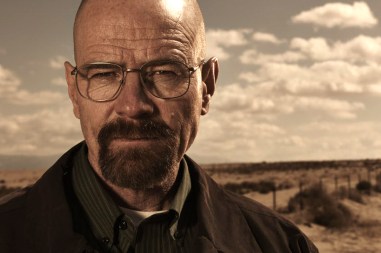
breaking-bad-hair-art
Tragedy. That one was easy.

What about the story of a guy too cool for school that has to go back to school and falls in with a group of lovable ragamuffins?

community-season-six-yahoo
Also easy. C’mon, it’s in the title.

Dan Harmon is the premiere television comedy writer of the decade(s), having championed Community (above) and half of Rick and Morty. Here are his rules of writing every episode of anything ever:

  1.  A character is in a zone of comfort,
  2.  But they want something.
  3.  They enter an unfamiliar situation,
  4.  Adapt to it,
  5.  Get what they wanted,
  6.  Pay a heavy price for it,
  7.  Then return to their familiar situation,
  8.  Having changed.

When you think of the Shakespearean definition of comedy, you see why this works so well episodically, especially with the Community series in which the zone of comfort is literally being accepted by a society. You have the tragic turn of an insider becoming an outsider, and then the comedic reintegration in a linear progression.

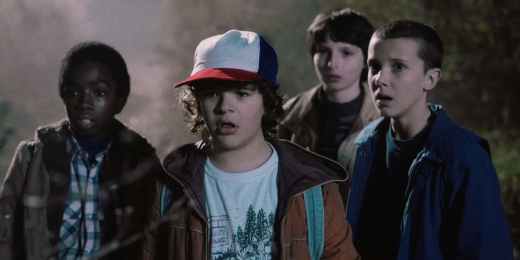
Sometimes you have comedies and tragedies playing out in parallel– take the story of a weird girl with psychic powers becoming best friends with a bunch of adorable dorks (integration) searching for their missing dork friend (broad integration):

stranger-things-on-netflix
Exploding G-men brains: comedy gold

…and mix it with the story of a sweet girl hanging out with a bunch of cool kids (integration) who drink beer and have sex and pay no consequences whatsoever.

barb-stranger-things-shannon-purser_article_story_large-large_transsfxwnnhossudzbpg8a9lxgnplncb4jbmotpfyxdp7d8
Oh right.

The tragedy of Stranger Things lies in the alienation of Barb– the cost Nancy pays to trade up into a higher in-group. You can chart out a hell of a whole lot of micro comedies and tragedies in that show and you’d still be hard pressed to label it solidly in either camp. Because it’s rooted in horror.  More on that later.

Now that we’ve covered the macro structures, let’s back up for a bit and examine the basis of all comedy so that we can cover the micro– I’m talking irony. The definition of irony is simply a contradiction of expectations. Now, the primary theory  of laughter is that it creates a social bond between those in a group, signaling that theirs is a safe place. I think of why I laugh nervously– to tell others that I’m not dangerous (or sometimes to awkwardly attempt to make a tense scenario a more amicable one). So let’s blend that with a model that explains why irony is funny to us on an evolutionary level:

A group of hunters are walking through the woods looking for food to kill. They hear some grass moving violently and they think it’s a tiger waiting to pounce on them. They send Kevin, agreed to be the biggest asshole of their group, to go and check it out– Kevin looks in the grass and finds… nothing. It was just the wind. He laughs to the other hunters to nonverbally communicate that everything is fine and they laugh back to confirm everything is indeed fine.

If you dissect that, you essentially have, in my terms:

  1. Set up (We’re hunting!)
  2. Expectation (Kevin’s gonna get et!)
  3. Punchline: A contradiction of that expectation (It was wind all along! We’re safe!)
  4. Return to normalcy (Hahaha! We’re hunting!)

That’s the basis of every joke ever written. You’ll notice it’s almost impossible not to tell a joke without telling a story and that it’s elements are not unlike any other particular scene.

I tend to write humorous books. Here’s the first paragraph of the 9th chapter of The Fish Fox Boys in which our heroes enter a dilapidated mall after the decline of civilization:

Adam and Fred walked carefully through The Mall’s vast, moss-covered corridors, past windows of the storefronts and restaurants that were now strangled by vines and shattered by trees growing through the glass. At first they were startled by what they thought were several people frozen in time, until upon closer inspection, they discovered that these were simply what the old world had called “mannequins.” Fascinated, they poked and prodded a mannequin sporting capri pants and a vest.

Without really thinking about it, I had written through those four steps:

  1. Set up (We’re walking through a scary old mall!)
  2. Expectation (There are frozen people!)
  3. Punchline: A contradiction of that expectation (Oh, those are just giant dolls wearing clothes! We’re safe!)
  4. Return to normalcy (Hahaha! Let’s poke ’em! We’re farting around in a scary old mall!)

A lot of that humor has to do with irreverent tone and pointing out absurdity, but the tone doesn’t become irreverent and the absurd isn’t examined until the end of the paragraph. And I’m going to posit that #4 is where the true humor lies (Let’s poke ’em!), instead of the punchline (Just mannequins!). If you think about how Mitch Hedberg delivers jokes, the laughter is almost always a beat after he says the punchline and comments how dumb his jokes are which also serves to recenter the audience before his next joke. You also have TV comedies like The Office where the punchline is delivered followed by a talking-head shot to capture the more human, often funnier reaction to the punchline (which also contextualizes the audience to the true nature of the characters on screen). The last step is even the funniest in the hunter-tiger model which tells the universal truth that laughter is contagious. You don’t need a joke to make people laugh, you just need laughter.

Back to horror (you thought I forgot! Shame on you!). A while ago, I had to the opportunity to see Robert Brockway read from the second installment of his brutal and genius punk-rock-horror series, The Vicious Circuit, and during the Q&A, a woman asked him how he could take subject matter that’s so inherently foul and horrific and still make it so goddamned hilarious. His answer was that the set up of a joke and the set up of horror is almost exactly the same, just with a different outcome. To use the hunter-tiger model again, there could have just as easily been a tiger waiting in those bushes to eviscerate Kevin. And writers like Brockway prove that the other hunters can still laugh at the end.

In my paragraph from The Fish Fox Boys, the punchline could have been replaced with a horrific payoff– that the people frozen in time were exactly that, stiff inanimate bodies standing around. Again, I think, what counts is the #4 Return to Normalcy (and how you define normalcy in your work). Fred and Adam could have screamed and runaway… or they could still poke the bodies and make fun of their clothing.

It makes a lot of sense to me, that laughter is so closely related to fear. We know that it’s the social cue of safety and the release of anxiety. It’s one of the reasons why going to a standup comedy show feels almost like a more powerful religious experience for me– the catharsis of that internal anxiety being coaxed out by a charismatic comedian and diminished by a room full of other homo sapiens telling each other nonverbally that everything’s fine. But that initial anxiety is necessary. You ever have to switch a sitcom off because it made you feel too anxious? Because you inadvertently mumbled, “Oh God”? Exactly. What makes us feel uncomfortable is also what makes us laugh. As a sidenote, I think that’s why slapstick was/is so popular. (See Buster Keaton’s House Falling on Buster Keaton)

It’s on that anxious axis that all  stories swivel.

But don’t forget that laughter is also the language of play and, whether you’re torquing the tension of a horror or a thriller piece or polishing the jokes and tone of a humorous work, remember that there’s a lot to play with here using the simple mechanics. And if you ain’t hip to this writing scheme, then, well, do what makes you laugh.

Unless that includes, you know, doing real-life horror stuff. GET THOSE KITTENS OUT OF THAT BURLAP SACK, KEVIN.


*I’m pretty sure that Shakespeare himself didn’t actually make those distinctions and that definition likely precedes the bad bard by some hundreds of years.