Unveiling the Illusion: Noir Nerdin’

Unveiling the Illusion: Noir Nerdin’

Spoiler alert up top: I’m going to delve into Chinatown, LA Confidential and True Detective. If you have any interest in being surprised by those works, you might want to stop reading now.

I’ve heard it around the way that a successful Sci Fi or Fantasy book reveals its built up world gradually through the fresh eyes of the main protagonist. I got to thinking that maybe noir does the same thing, except in reverse– we’re introduced to a fantasy and then what follows is the revelation of our very own dark and gritty universe (usually) through the eyes of the protagonist who can see the true, underlying reality.

In my post on character sketching, I quoted Raymond Chandler’s bit on Phillip Marlowe. The relevant piece is this:

The story is this man’s adventure in search of a hidden truth

That’s not breaking any minds to tell you that The Detective archetype is searching for some veritas in noir detective fiction. But I want to pause first on why these guys feel the need to pursue that hidden truth, or rather, what makes them the type of character that knows something is there.

Sherlock Holmes is a good place to start. He solves crimes by deductive/inductive reasoning. He looks at something from above and in the solving of the case, elevates the crime to his own level. He’s simply smarter than the crime.

But noir heroes slum along the bottom. The Noir Detective yanks down the case to his level. Because his world is the truthful one and the illusion spun by the conspiracy of his social betters doesn’t sit well with the reasoning of the cynical world.

In the first season of True Detective, Rust Cohle has been through the hell of losing a child and living deep undercover for years, well acquainting him with the pain of living and how the criminal world operates. When he transitions into a homicide detective, he’s aware that the structures in place are illusory– he can sniff corruption on his fellow police and the investigation is being misdirected by an invisible hand. Cohle also extends this to the broader subject of the world:

“It’s all one ghetto, man, giant gutter in outer space.”

Rust works outside of the agreed upon societal norms, because he outright rejects them as an illusion. He rejects authority, he rejects human relationships, he rejects society. Which is what makes his and Marty Hart’s relationship so powerful– Marty is discovering that his suburban American dream is ultimately immaterial, realized in the bitter disintegration of his marriage and the troubling sexual pressures his daughters encounter. And he’s ultimately powerless to stop it (owing to his own sexual infidelities, alcoholism, and heavy handed parenting methods). It’s only when Marty is dragged to the bottom, to the world of harsh truths where Cohle is waiting for him, that they are able to finally solve the murders.

The mechanism of noir is the progression of interviews and interrogations. In there lies the fabric of the illusion– everyone provides deceitful information to obfuscate the truth. Let’s take a look at Chinatown in which Jake Gittes (a veteran of the harsh realities in Chinatown) is approached by Evelyn Mulwray who turns out to a be an actor. The water department covers its tracks of diverting irrigation to the orange groves. Hollis Mulwray is found drowned in freshwater, but had salt water in his lungs. Katherine Mulwray is supposedly Hollis’s mistress, before it’s revealed that she is Evelyn’s sister before [redacted]. Everything seems to be positioned in such a way that it seems normal at first glance. By the end of the film, every threaded lie is unspun and what remains is a sinister and grim reality dressed up as a caper. In other words, it’s still Chinatown where base crimes are the norm and it turns out that the rest of LA is no different. Again, normalcy is the fantasy.

Also, how good is it that Gittes gets his nose sliced up, metaphorically making him an impotent detective coinciding with him unable to decipher the pageantry in front of him? Pretty sweet.

There’s a lot to play with here and a good example of flipping this script is James Elroy’s LA Quartet. If you think about the main characters driving the novels, they are actually somewhat naive and too obsessed with outperforming their peers to realize the fallacy the of the criminal justice system they participate in. Perhaps because of this, they are often casualties of their own investigations, one way or another. Meanwhile, the common thread through all of these stories is the ever terrifying Dudley Smith, a man who understands the dark reality of crime and departmental (even federal) corruption. Instead of being a The Noir Hero, he chooses to perpetuate (and occasionally even create) the illusion to benefit himself financially and further his career. I can’t think of a better noir villain than Dudley.

At the end of the day what you have is a character interacting with the setting. Interacting is the operating word. I feel as if many books in various genres offer a passive protagonist who allows the world to happen at them. What I appreciate about noir is that the protagonist digs his hands into the guts of the setting and shows the reader its entrails and shouts, “THIS! THIS IS WHAT WE’RE MADE OF.”

Perhaps there’s a lesson in that for all of us.


If you’re a fan of noir mysteries, perhaps try my hardboiled detective novel, Muddy Sunset. It follows PI Roy DeLon through the streets of St. Louis 1955 as he untangles a web of MS_cover_smallcorporate deceit, murder, and treason. You know, casual stuff. It’s available in paperback and kindle formats here.

Routine: more Art than Science

Routine: more Art than Science

I’ve been trying to get on a consistent writing routine and almost every author who gives writing advice provides the simple maxim, “Write Everyday.”

I’d like to add the caveat, “…except when you don’t.”

Days and weeks are busy. If you, like me, work a joe job schlepping for the man, then you’ve got to take care of the time you have with some delicacy. You need to unwind, you need to eat, you need to be (occasionally) social, you need to  read and ingest other forms of media (which is half of what this writing gig’s about). And you need to write.

I myself have been trying to hit a quota of at least four times a week. In my more frantic pushes to finish projects, I’d set aside 4-6 hours at night of non-stop writing action. The results were very productive– I’d get over 20,000 words a week. That’s not always possible but what I learned from that is that it helps to anchor your routine to rituals. My rituals were:

  1. Brew a pot of coffee at 6 PM
  2. Drink coffee, start project, catch up with Twitter
  3. Get a burrito between 7-8 PM
  4. Eat burrito while writing
  5. Brew decaf pot of coffee, see what’s happening on Twitter
  6. Get zoned in on writing until 12:30 AM

It’s probably not the most feasible schedule ever written– I’m not entirely sure I can write off burritos for tax purposes– but that framework of regularity took care of life’s stressful little details such that I could focus on the work. If I got lost along the way, I knew how to click back into the groove (“Oh, I haven’t brewed the decaf yet. I’m on it.”). I also knew when I was going to stop (which is sometimes more of a suggestion if the writing’s hot).

You’ll also notice that I included farting around on social media into the routine. I feel like it’s necessary to distract yourself a little bit to keep the gears in your head properly oiled. Writing emails, chatting a buddy on Facebook, Tweeting, these are all ways to exercise the writing component of your mind, while also exorcising certain ideas that have no place in your fiction (e.g. if I have a joke that’s inappropriate for the book I’m working on, I’ll throw it on Twitter or simply just send it to a friend, instead of trying to jam it crudely into some prose).

These days I’m allowing a little more time to finish projects, I find myself asking myself the question of setting up a word count quota. How much should I get down?  I’ve used quotas in the past and they can be incredibly helpful. In fact, I still use them but I’ve ratcheted it down to ~400 words per session instead of 1,200.

Because I think the more important thing to set up is the time allotted to write instead of a hard number to hit. You ever read a listicle that tried so hard to hit the word count that it strung a sentence along twice the length it needed to be? There are tales of NaNoWriMo cheating their word counts in all sorts of ways– and it misses the point. If you set up a beginning time and a finishing time, you’ll hit your quota. You’ll exceed it beyond your wildest speculations.

I still haven’t created a perfect schedule and I’m still tweaking what works. There are the days where I just squeak by with the minimum 400 and then there are days when I can’t stop and I’ve got 20 more pages compiled. And maybe that’s just what works for me– like a runner training for the big marathon.

So, if this entry has a point it’s this: The big push will yield a big pay off, but so will the accumulation of regular sprints. You just need to make the time.

If you’ve got suggestions, hey, lemme know.

Anti-Intellectualism and The Case AGAINST Mediocrity

Anti-Intellectualism and The Case AGAINST Mediocrity

In one of my previous entries I wrote about how mediocrity can be inspiring– in the sense that it can fill you with the confidence to at least match the quality. At the hazard of contradicting myself, today I am going to beg you to make your content as good as humanly possible. 

Media causes ripple effects in society. I’m not an alarmist about how millennials are getting lazier and dumber by the second because on the whole, I believe that to be patently untrue and anyone who tells you otherwise is trying to get you to vote for somebody. But I do recognize that during this transitional period of how we ingest our media, it tends to be indulgent (I’m not judging. I watched Stranger Things in a single day) and since our media has (ironically or no) saturated nearly every second of our lives, it’s important to check the diet of what we’re consuming.

The recent presidential debate was entertaining as hell. I know I had a good time on Twitter. But the fact that it’s become entertainment is a little disconcerting. On one hand, it’s getting people involved with politics. On the other, people are examining the performances of the candidates instead of the policies they’re proposing. I think our media has a lot to do with that–to compete with Game of Thrones, the presidential debate had to be a bit of a shit show.

As content creators, we have an opportunity (I want to say responsibility, but that’s a troublesome word) to engage our readers with critical thinking. That can be hard to juggle with the “entertainment value” of what we’re trying to create. I totally understand if you’re coming at it from the angle, “I’m an entertainer, I just want to help people unwind and escape their problems for a little while.” And that’s noble in and of itself. But what’s gained there if that’s all there is to it?

We live in a day and age where we hide in our bedrooms and watch Netflix until our eyes bleed. We play (awesome) video games that average to over 100 hours of playing time. We stare into our phones to avoid the awkward eye contact one might accidentally exchange on the bus. We indulge a lot of escapism. And sometimes that’s what we need. Feel no shame for escapism.

Perhaps feel some shame to what you’re escaping into, if there’s no merit in it. I know, I know, one can wax poetically and existentially on the Godawful Friday by Rebecca Black. You can create meaning in things that are otherwise devoid of any inherent value. And I will defend the honor of dumb action and horror movies until the end of time– is there any real lesson in The Friday the 13th franchise? Did I learn anything from A Nightmare on Elmstreet? Perhaps, but then again, maybe I’m projecting meaning onto those films, instead of gleaning any actual truth. They’re fun, but they aren’t challenging in any way. The same reason people like me dissect pop culture philosophically, is why kids often act out in school–they aren’t being challenged. 

That’s the word of the day right there: Challenging. I look to Jurassic Park as the perfect example. As a movie, it’s thematically perfect. It’s entertaining, it’s scary, it’s satisfying in the triumphant ending. And it also challenges the audience on issues of the role of mankind in the natural world, a challenge that is becoming more and more relevant. It also challenges gender roles, and asks the question frequently, “What does it mean to be a good parent?” Those questions vary in subtlety and are never preachy except for one siiiick example. You can walk away from that movie, fully entertained and unaware that the film was poking at those issues and still have those questions brewing in the back of your mind. And the book? Wonderfully dense with a lot of science jargon that adds another layer of complexity to decode to keep up with the pace of the story.

I don’t want to disparage other authors out there, or some of the incredible entertainment that’s been coming out. But I’ve seen the depths of what independent publishing can produce and people have purchased and consumed terrible, haphazardly written products in this brave new world of publishing. Not only are those books a scam (which hurts all of us, as a reader burned by an indie will be less willing to buy a book by another) it also stokes the fires of ignorance. We need to hold ourselves and each other accountable for the content we create, be it social media, blog posts (ahem), the books, songs, and films we write. It needs to challenge us first, make us ask ourselves the hard questions before asking the audience to consider our musings.  It’s important to remember that we aren’t just a product of the world we live in, we actively create it.

So let’s work on creating smart entertainment.

I’m not saying you have to be ambitious. I’m not saying you need to remove the wool from the eyes of masses and expose them to some forgotten truth about the world. I’m just asking as a fellow writer to try and instill a sense of purpose in your work, because that’s what’s going to resonate the most with the readership.

That and fart jokes.

Whatchu Know?

Whatchu Know?

The most hated question in interviews and Q & As with authors is probably “Where do you get your ideas?” Because the answer is almost always either a contemptuous shrug or the clichéd “From the world I live in.”

It’s kind of funny, because the latter is what writers are taught early in their career with the tired adage, “Write what you know.”

I think there are times when writers mistake that advice for “Write about my life.” There was an older woman in one of my fiction courses who wrote a really personal story about the day her ex-husband was released from jail. It was a deeply moving story… or it would have been, if it had been properly constructed. But when criticized, the writer took it personally, going as far as quitting the class then and there.

I think the danger is, when you transcribe your personal life into a fictional setting, is that you want the details to match up with your own memory. This doesn’t always fit the story and making the concessions to make it fit damages your own memory of events. Save that memory for yourself. If it’s funny, save it for parties. If it’s tragic, save it for therapy. This is you we’re talking about here. Keep yourself whole and don’t exploit your life for a chapter in a book.

Fiction isn’t a diary. It can be hard to remove your personal stake from a piece of fiction during the editing process. When it comes time to “kill your darlings,” and those darlings are “factual events that happened to you,” you will find yourself in a bit of a quandary.

“But how do I write what I know?”

My advice (which is probably advice given to me that I am repurposing here for your pleasure) would be to start recording how you interface with the world around you–going back to the answer up top on “how I get my ideas.”

Your friend is talking. How are they talking? Are they sad, happy, neutral, bored? I’m cooking dinner. I feel ____ when I cook, because ____. This rock that I’m holding is crumbly. It reminds me of _____. It’s windy right now. People are walking ____ in reaction to it.

A personal example of this is when I wrote a scene in which the main character is gifted pickled herring. A friend who read the chapter’s only statement on the chapter was “How the #$%@ do you know what pickled herring is?”

And the answer to that is I had pickled herring on saltines with my grandmother years ago and it seemed like a thing that old neighbors would gladly gift someone, and the kind of gift that you’d be thankful for, but not particularly excited about.

I used a memory from my own life, took out the detail I wanted, figured out why I thought it worked and wove that into the story I was writing… without writing the scene between me and my grandma.

I’ll have more thoughts on this later (I have more thoughts on everything all the time).


Character Sketching: Dungeons & Dating Websites

Character Sketching: Dungeons & Dating Websites

The first book I wrote (that has still gone unpublished, a-boo-hoo) came from the desire to summon a character into literary being that was so chaotic and anti-authoritarian (yet ultimately harmless) that he would rip through whatever situation I placed him in and get me to a finished manuscript. He did. Over the course of 50,000 words I got to know the guy. Then I threw 90% of the book away and started over (as is the fate of first drafts of first books), this time with more intimate knowledge of my character. I started with a concept and ran it through a machine of events and conflict. Ding! A character was born.

So as not to waste that much time and paper, however, character profiles and sketches were invented to save the author some hassle. It’s helpful to have a reference for all of the dramatis personae flying around a story. I agree. I have a hunch, however, that a lot of profiles focus on the character’s appearance (which usually translates to dry prose when described over and over…) or their general backstory (which can be interesting, if you go into one or two character’s histories in a novel, but quickly turns into a slog).

Writing a character profile is difficult, I think, because it’s hard to describe ourselves. You lovebirds on OKCupid know what I’m talking about– when there’s a gun up to your head to describe yourself, you end up talking about the music you like, the hobbies you enjoy, and how invested you are in your career. Vague. Which isn’t always a bad thing.

It’s better than, “Hi! I’m Dina! I’m 5’7″ I wear black eyeliner and leather boots with black jackets with pink buttons with little butts engraved in the copper and when I was growing up in an orphanage by the dragon lagoon, I found a pendant that farted when I prayed to it…”

It’s even harder to describe other people. Enjoy this familiar scene I have prepared for you:

“Tell me about Steve.”
“He’s funny.”
“Oh?”
“And smart.”
“I bet he’s shy, as well.”
“He is a little bit shy, but really fun once you get to know him.”

Uncanny, right?

Now here’s the Godfather of noir, Raymond Chandler, describing Phillip Marlowe:

“down these mean streets a man must go who is not himself mean, who is neither tarnished nor afraid. He is the hero; he is everything. He must be a complete man and a common man and yet an unusual man. He must be, to use a rather weathered phrase, a man of honor—by instinct, by inevitability, without thought of it, and certainly without saying it. He must be the best man in his world and a good enough man for any world.

“He will take no man’s money dishonestly and no man’s insolence without a due and dispassionate revenge. He is a lonely man and his pride is that you will treat him as a proud man or be very sorry you ever saw him.

“The story is this man’s adventure in search of a hidden truth, and it would be no adventure if it did not happen to a man fit for adventure. If there were enough like him, the world would be a very safe place to live in, without becoming too dull to be worth living in.”

Damn, right? Here’s a few takeaways: Chandler is focusing on values. On basic motivations. On attitude. He knows how Marlowe is going to handle any situation, before he knows what the situation is. That kind of confidence is what can allow you to improvise.

Let’s say you write a scene in which your hero is fleeing a kill-squad of robots, only to run into her evil twin brother, wielding a machete. BAM. Writer’s block. You flip to your character sketch. It says, “She has a sick belt buckle.” Oh no! You keep reading. “She’s really funny.” That could come in handy later, but is currently useless. “Highly aggressive and brutally violent to a fault.” Phew, you exhale, wiping perspiration off of your brow. Now you know that you hero would kick her brother in the chest, grab the machete and start swinging wildly at robots until they overwhelm and imprison her for robot crimes.

Bad example, but you get the idea.

So how about this? Spend some time making character profiles (even with your currently written ones) and identify some key characteristics.

  • “What is their general attitude?”
  • “How do they respond to conflict?”
  • “What is their way of speaking?”
  • “What do they find despicable?”
  • “What do they believe in?”
  • “How sick is their belt buckle?”
  • “What can break them?”

Once you have the answers to this, or a list of rules that summarizes those values, you should have a pretty keen mental shorthand of your character’s behavior in addition to a concrete reference.

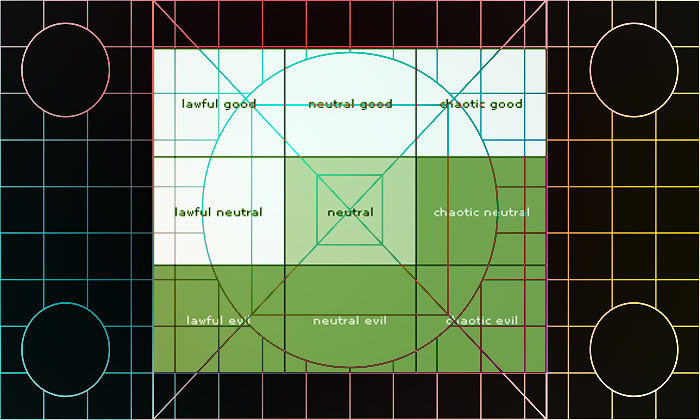
And hey, while you’re rolling your character’s stats, you might as well take another page from Dungeons and Dragons and try using the alignment spectrum and decide where you character falls and why. Want to use archetypes? Consult the enneagram which offers motivations behind archetypal behaviors.

Tired of writing? That’s cool, too.

Take a break and get to know thyself.


The Power of Mediocrity

The Power of Mediocrity

Here’s an exercise you can do the next time you go to the bookstore: research your favorite writer’s whole catalogue and figure out their worst book.

Go buy that book. Read it. Cringe through it. Note its virtues.

Now ask yourself if you can produce something at least as good as this. Chances are that you can.

With Self-Publishing allowing for anyone to enter the arena of fiction writing, there are no standards in place that would prohibit inferior works from reaching readers. Books are often error-laden and stiffly, quickly-written and lean more on heavy marketing than quality of the product. I’d advise that you be honest when reviewing their work– or if they ask for a review, be polite and decline.

But also note that you can publish something better than this. You can correct the market quality by the taking the time and thoughtful care to go over your book many times. Have friends and family review them with you if you can’t afford an editor. (I can’t. And errors keep popping up even years later.)

Make it the best damn thing it can be because even if it doesn’t make a lot of money, it can outpace at least half what’s out there, or, at the very, very least, it can’t do worse.

And that’s still a success.

Zelda as a Writing Tool

Zelda as a Writing Tool

My last post was about tapping into a mental state to encourage an improvisational approach to writing fiction. I don’t want to give the impression that writing fiction doesn’t take a whole helluva lotta consideration of organization and presentation or forethought.

What I am proposing is that there’s some mental shorthand you can use to make story telling fundamentals a little more intuitive. I learned this through the necessity of being a borderline criminally disorganized person.

What I mean by mental shorthand is a concept you can feel and visualize in your mind in place of a quantifiable, rigid set of rules. Think of it as a nemonic device for the fundamentals.

Let’s start with narrative structure. Fiction demands you pay attention to this. It’s one of the hardest things to grok (especially after you’ve written a complete work) and it takes reading piles of books and scrutinizing their organization with the intensity of a serial killer. If you don’t know where to start, I highly recommend revisiting Shakespeare (5 Act structure) because all of his work is separated neatly into acts and because you won’t be able to understand 70% of what’s being said, you’re more likely to feel how a scene plays out instead of relying on what information is being shared.

There are far better pieces on the basic elements of a story (if you aren’t familiar with The Hero’s Journey, or The Rules of Fairy Tales, or the Act Structure give those links a read. Sorry that the fairy tale link is so crappy. Best I could do.)

So, what serves as good mental forehand for story structure? What about, say, the game design of a dungeon from The Legend of Zelda? (Nerd alert: I’ll be in the cafeteria trading rock collections if anyone wants to give me a justified ass-kicking.) There’s no denying that by any reasonable standard, The Legend of Zelda: Ocarina of Time is nearly a perfect video game. I like to use it as an example, because I’ve played through it so many times, I can mentally pass through almost every dungeon to the point that I can give somebody a pretty thorough walk through over the phone while I’m cooking dinner. Maybe your mental shorthand, or fundamental allegory, is a movie, or a painting, or a concept album. Maybe it’s a sick skate video. Maybe you’ve got it in your blood. Me? Zelda.

Let’s break down a Zelda dungeon.

  1. You enter and familiarize yourself with the atmosphere, and are given the task to complete the dungeon.
  2. You encounter enemies and puzzles of increasing difficulty
  3. You get to a point where you cannot continue without a specific tool
  4. You fight a mini-boss and receive the special item
  5. You utilize this special item to defeat and complete harder enemies and puzzles.
  6. You face and defeat the boss in an epic battle of Man v Monster
  7. The Dungeon resolves, you get a heart container and a piece of the plot is revealed

What the game designers knew is that they are driving a story through the format of game. They knew that that having the puzzles that you can’t solve without the item don’t have a place in the beginning. There needs to be build. They knew that you can’t have the mini-boss in the beginning or after the final boss battle. They knew that situations need to be developed such that the player gets better at the game before offering new challenges. they know that they have to offer rewards and they know where and when to place them. That’s what creates the story of a hero overcoming gradual conflicts.

Now let’s write a quick and dirty mystery plot with a few switcharoos.

  1. A detective is tasked with solving a murder of a senator.
  2. There are interests, I don’t know, The White House, that don’t want the case solved
  3. The detective loses a fist fight with another gumshoe
  4. Suspecting his rival for the murder, our hero follows him and learns that while he’s innocent in the murder, he’d been hired by The White House to jam up his investigation.
  5. Our hero throws this information in the President’s face, threatening to contact the newspapers and the President backs off
  6. Free from misdirection, the detective solves the murder. The Senator’s cat did it or something.
  7. The Detective leaves and contemplates the events of the story, inquiring for meaning in a bleak and cynical world.

It’s not a great story, but you can see how the beats match up to the break down of the dungeon. You can also apply this to the micro level in individual scenes to make sure that the scene stays active. I confess I’m not always on point with this, largely in part because I think it’s funny to let a scene sit awkwardly for an extra beat and have characters argue with each other before proceeding (which is still conflict, so hey).

I bring this up because making charts and lists and spreadsheets is tedious work and if you, like me, are something of an improvisationalist, then it’s a lot easier to feel out your written world in terms of something familiar and fun instead of clinical and boring.

There’s a good chance you’ll have to make a chart or timeline anyway. But that shouldn’t mean you should rob yourself of fun methods in your toolbox. Enjoying writing and producing working fiction needn’t be mutually exclusive.

Hi there! Are you here to see my wicked rock collection?


Writing as Improv

Writing as Improv

First, a suggestion: If you are a hopeful writer in high school or college, the absolute best advice I can give you is…

Take theater.

Second, an explanation: Me and my friends get together and discuss our current projects semi-regularly. Because I live in Portland, most of these friends are musicians. We got to talking recently about the concept of “flow” and what it takes to improvise musically.  It means practicing your technical skills repeatedly and then turning your brain off.

Here’s an article what happens to your brain while free-styling rap, the cut of the jib of which is:

The areas implicated in processes like organization and drive were marked by an increase in activity, while those parts responsible for close self-monitoring and editing were deactivated.

I think it boils down to trusting that one knows their technical skills are there and by tapping into one’s subconscious, that it will automatically organize itself into a song. It’s like having a dream right? The majority of us are not film directors and yet we build sets, costumes, create characters and write dialogue all while our brain is supposedly “off.”

The famous quote of comedic genius Del P. Close is “follow the fear.” Fear is the mind killer and, in art, that might actually be a good thing. It’s a way to shut out the ego and trust your own instincts.

I want to bring this discussion to a classic argument shared by writers: “To outline or wing it?” Nearly every reading I’ve gone to, this question is asked and the answer is always the same– “it’s up for debate, but I personally need to outline my own books, so I don’t lose track of yada yada yada…” But what about the other side, the “wingers”, that don’t plan ahead? Another quote to the rescue:

“Writing is like driving at night in the fog. You can only see as far as your headlights, but you can make the whole trip that way.”

Thanks, E.L. Doctorow. And I agree with him. Well, how about that I agree with both? If you’ll indulge me about my own writing process, I make a loose, looooose, outline that’s almost never more than 1-2 sentences denoting what needs to happen per scene. If I have a complicated web of relationships (such as in Muddy Sunset) I’ll spend some time figuring that out ahead of time in a notebook and set it aside. As far as the actual writing goes, I take those 1-2 sentences and then I improvise.

Authors often say that this causes the problems of 1. Creating more work later (true) and 2. is messy and inconsistent (not always true) because 3. Without a plan, you are lost (often true, but not always a bad thing).

To which I want to ask the following question: If I know I’m driving to the beach and have three hours to do so, does it really matter what road I take? Recall any family vacation and I almost guarantee you that the thing you remember most is where you stopped along the way, not the actual mind-numbing highway through Kansas (sorry, Kansas). Or you remember changing a tire, or waiting for the tow-truck, needing the bathroom 75 miles away from the nearest gas station– you remember everything that hadn’t been planned or accounted for. Not having everything in place ahead of time allows for spontaneity. I try to maintain a rule that I need to surprise myself at least one time per scene. If I, the author, am surprised, there’s a fantastic chance that the reader will be surprised as well.

Another quote, this one by Raymond Chandler, a personal hero of mine:

“The faster I write the better my output. If I’m going slow, I’m in trouble. It means I’m pushing the words instead of being pulled by them.”

This too speaks of tapping into that fugue state, and following the subconscious instinct in storytelling.  It’s about trusting what lies beneath the topsoil of your brain, that’s there’s something special under there and it’s up to you as the writer to uncover it and show it around. Maybe your tools haven’t been sharpened (it’s a lifelong game, and no one ever reaches 100% perfection) and if that’s the case and you don’t trust yourself yet (or perhaps too much) there are many viable spaces online to practice and get feedback.

So back to the beginning. Hopeful writers still in school: take drama. Participating in theater during high school helped me nearly as much as taking creative writing and standard English courses. Theater taught me…

  1. To improvise.
  2. To embrace the fear of performance.
  3. To step inside a character’s psychology, physicality.
  4. To shut my own brain off and go with “The Flow.”

These are the lessons that don’t get covered in English courses (“But what does it mean?“) or creative writing courses (“What does Raymond Carver teach us about Craft?”).

If you aren’t in school and find yourself stuck with writer’s block, perhaps try to engage the subconscious mind and participate in other disciplines: music, theater, drawing.

You might be surprised what your brain has in store for you and your story.


You can celebrate my first post by reading my first book, The Fish Fox Boys Part One. It’s about a trio of siblings bumbling around in the wasteland and you can purchase a paperback or kindle version of it herere_cover_small