Genre vs Fiction: FIGHT!

Genre vs Fiction: FIGHT!

There’s an interesting divide in the academic literary world based on the question of “what constitutes Literary Fiction?”

This rift has spread to the publishing world. The Literary Fiction camp holds the belief that Genre Fiction writers are cookie-cutter sellouts, pumping out as much trash as possible to earn a quick buck. Whereas the Genre Fiction camp views the Literary Writers as idealistic snobs, writing from an ivory tower and waxing poetic in ruffled shirts.

With some of the stubborn and pompous attitudes of literary authors and all of the garbage self-published on Amazon, it’s hard not to agree with both stereotypes. But I think if you want to get in the habit of writing successfully, you need to understand and aspire to both schools of thought.

Speaking of schools, here’s a story from my last class I ever took at University. It was a Renaissance Fiction Class, 400 hundred level. Through all of the reading, we were asked a simple question: is this Literature? No one, not even the teacher had a solid definition of what that meant. The vague answer is something like, “a written work that has literary merit,” which loops infuriatingly into itself.

The term began taking upon its popularity as its own thing around the time travelogues came into vogue–somewhere in the early 1500’s– and it’s easy to understand why, as a written, true account of a journey strikes on the “beginning, middle, and end” narrative structure naturally. These were supposedly non-fictional accounts, but there’s no doubt that details were embellished. The trend of intentionally fictionalizing these travelogues is traditionally credited to Sir Thomas More with his work UtopiaWe also read a bunch of martyrologies, another supposedly non-fictional account that has some, shall we say, mystical qualities to it (in addition to being objectively metal). With every chunk of reading we were asked if this was literature. 

More questions followed. Does literature have to be fiction? (A: “Not… really?”) Does it have to be interesting? (A: “Apparently not, because travelogues are boring as hell.”) Does it have to share significant insight into humanity ? (A: “Uhm, hmmm.“)

One answer was certain: that everything we read was written to the guidelines specific to a particular genre.

Another question: Was this considered Literature at the time? Nearly everything we hold in literary prestige garnered its accolades long after the author died. Shakespeare’s works didn’t get the literary treatment until the 20th century. Mary Shelley’s Frankenstein is a horror novel. The Great Gatsby was considered a failure until after World War II. Is it literature? (A: “Let’s sleep on it and figure it out next century.”)

Now, as far as it relates to the publishing world, a distinction between literary and genre fiction can be made. As far as I can tell, the difference is this:

Literary Fiction focuses on introspective character studies that attempts to reflect a philosophical truth of the modern age. The character dictates the plot.

Genre Fiction focuses on universally recognizable characters driven to make choices by external actions. The plot dictates the character.

Modern fiction necessitates an overlap– Don Delilo’s White Noise, for example, ends a meticulous and surreal study of a modern family with elements borrowed from a thriller. It’s in that overlap that you should aspire to. On one hand, learning and understanding the conventions of basic storytelling is important, because those elements don’t really change over time. Our brains are wired to understand stories and, ideally, you want the reader to understand and enjoy the act of actually reading your book. On the other hand, you should give a shit and try to make your work as affecting and relevant to the world around you as you possibly can.

Because at the end of the day, literature is like pornography. No one really knows what it is, but we know it when we see it.

Out of Frame

Out of Frame

I got into an argument with my favorite bartender recently about the genius of Baz Lurhmann. His argument was Moulin Rouge. My counterpoint was The Great Gatsby.

Ahem.

Baz Lurhmann’s The Great Gatsby is heartwarming tale of how a writer-director can take what is arguably the most American novel of all time and transform it to a staggering monument of cinematic piss. At 2 hours and 23 minutes, the film is a bloated psychedelic music video that is bookended by the frame narrative of Nick Carraway writing the book while being treated for alcoholism in a sanatorium.

While certain critics will defend this retcon as an innovative insight into F. Scot Fitzgerald’s life, which indeed spiraled into alcoholic chaos, it’s important to note that Fitzgerald wrote Gatsby in Europe, relatively comfortably, and that it was, in fact, Zelda Sayre who actually wrote a book while in psychiatric care.

You could say the use of the frame narrative device is similar to that of the cinematic adaptation of Naked Lunch, but that argument does not hold an ounce of water (or… gin?)–the film Naked Lunch is a schizophrenic journey of pornographic, junkie appetites that desperately needed narrative grounding, whereas The Great Gatsby is already a complete narrative, rendering any additional storytelling device unnecessary.

It’s kind of frustrating when you read Luhrmann thoughts on his own direction:

“What scenes are absolutely fundamental to the story? What scenes must be in our film? And what scenes can we do with out, even if we love them?”

Luhrmann isn’t really known for discipline in his movies. And that’s fine. He’s about spectacle and I can respect that. But when you pair the above quote with the one below, from the same interview, my mind explodes:

“in the novel, Fitzgerald very deftly alludes to the fact that Nick is writing a book about Jay Gatsby in the book […] – “Reading over what I have written so far…” So Craig and I were looking for a way that we could show, rather than just have disembodied voiceover throughout the whole film, show Nick actually dealing with the writing[…]”

That’s a wide reach to justify the choice of framing the narrative in the film. If I had to guess, Baz either wrote (or directed) his way into a corner, and the focus on Nick Carraway was his solution. I respect that writing involves a lot of creative solutions for the problems you give yourself and a frame narrative might actually be helpful. I’ll even say that the subdued shots of a novel being organized was some of my favorite imagery used in the film, because I’m a gigantic dweeb.

But I’ll take this explanation to task as the Nick storyline is the very definition of visual “telling” and not showing. It’s making literal what was initially implied. Many book adaptations mention that the narrator wrote the book that you hold in your hands– without having to wedge apocryphal material in to justify it.

And if you want an example of perfectly adapting a narrator into a film, look no further than Netflix’s A Series of Unfortunate Events. Which proves that it’s doable without coming off as heavy-handed.

But maybe I’m bitter because when I watched Gatsby in 2013, I left the theater angry because the novel I was working on at the time began with a frame narrative taking place in a psychiatric hospital. When I saw the trope play out on screen, it came off as cheap and melodramatic. I changed it immediately as soon as I got home.

Why did it come off as cheap? How did the device actually change the story?

In Gatsby, the frame device put a lot of weight on the story itself– that’s what a frame narrative does, looking back to a time with a different perspective– and shifts the perspective of the interior story away from a ruminative reflection on the foibles of greed, the emptiness of shallow relationships, the tedious culture of high society and the meaninglessness of achieving the American dream through ill-gotten gains to a brooding, traumatized perspective that undercuts the significance of anything else.


But in the end, The Great Gatsby (2013) got 48% on Rotten Tomatoes, which is a score a high school English teacher would give a book report presentation if it was just Baz Luhrmann nodding along silently as a Jay-Z album played through.

Then again, Robert Redford’s 1973 Gatsby vehicle got 39%. The one in 1949 has a score of 38%.

Maybe we should just leave Gatsby alone.


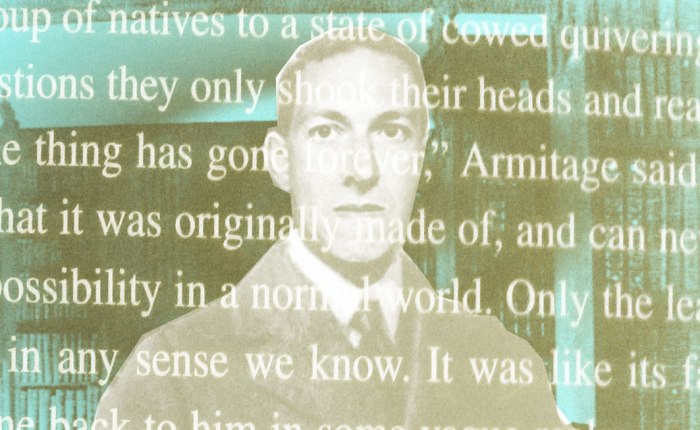
Digging Into Horror – A study in HP Lovecraft

Digging Into Horror – A study in HP Lovecraft

I have a few highlighted passages in Starry Speculative Corpse: Horror of Philosophy Vol. 2 by Eugene Thacker with my annotation, “aaaaaaaaah!” written next to it. Here is the first:

…something exists, even though that something may not be known by us (and is therefor “nothing” for us human beings)… (p. 41)

Shortly thereafter, I have this highlighted:

Darkness is the limit of the human to comprehend that which lies beyond the human… knowing of this unknowing… the conciliatory ability to comprehend the incomprehensibility of what remains outside… (p. 41)

Next to which I have annotated, “we only know so little about how we only know so little.” I then highlighted the following:

…there is nothing outside, and that this nothing-outside is absolutely inaccessible. This leads not to a conciliatory knowing of unknowing, which is really a knowing of something that cannot be known. Instead, it is a negative knowing of nothing to know. There is nothing, and it cannot be known. (p. 42)

I have annotated, “we don’t even know what we don’t know,” followed by “aaaaaaah!” again.

Cosmic horror is more or less predicated on these principles– that we are insignificant and blind to the order of the universe, allowing for the possibility to dream up monsters of the dark that are, by our nature, incomprehensible. The general conclusion of most stories that fall into this genre is that a character having been exposed to the unknowable will inevitably go insane.

All horror on some level follows this notion, whether intentionally or not– good horror allows our own minds to scare us instead of the monster on screen. Jaws famously buried its shots of the shark under several iterations of editing, John Carpenter’s The Thing never shows the true alien’s form (only the perversion of the host’s body it’s replicating), Jason Voorhees and Mike Meyer’s hide behind dehumanizing masks, and Sam Raimi’s Evil Deadzoomcam” follows from the perspective of the damned, but we only only see the evil manifested in the body of the possessed victim. The monster loses its potency once you see it in the light– once it’s realized, it can be killed.

So what sets the works of HP Lovecraft apart from the rest is how he’s able, in prose, to bury the horror so deep that it gradually creeps up on the reader. At first it seems like a magic trick. Until you see the cards.

The culmination of reading HP Lovecraft is unlike anything else I’ve read: for me, it was a joyful experience. I tried to pay attention to how Lovecraft crafts that lovely feeling.

First, he tells you the ending up front, usually in the first sentence of the story. From Dagon: “I am writing this under appreciable mental strain, since by tonight I shall be no more.” You know from the outset that the narrator is insane and will be dead soon, likely by suicide. It reminds me of the theory that spoilers only enhance the enjoyment of something, because you know what you’re looking forward to. It’s a clever device that answers a question and asks another– you know the ending, now don’t you want to find out how it got there? Eh? It also plants a seed of anxiety in the reader and puts them on edge– they know something’s going to happen, just not when.

You’re going to need that little push to get through a lot of his work, too, because HP apparently loved writing in arcane language. Most of his work came out in the 20s-30s, so it’s pretty dated by modern standards–and by the standards of the time. It’s dry and academic and I’m 90% certain that it’s written stiff on purpose. I kind of love this because its so antithetical to Lovecraft’s literary contemporaries– whereas Hemingway and EB White preached “brief and concise” to get the idea across effectively, Lovecraft prefers “vague and elevated” language to confuse the reader. Reading the geographic descriptions of a simple landscape often gets convoluted in its crags and valleys and deviations, such that the reader becomes lost. When describing “cyclopean” architecture and the horrific attributes of the ancient alien creatures, the high-brow, academic language remains indirect and it fails in its description. It’s supposed to, as what’s being described is unknowable.

A note about the academic tone worthy of mention is how seemingly tangential it is. At The Mountains of Madness, for example, Lovecraft spends a frustrating amount of time establishing a consensus on the best arctic drills to use during expeditions; The Whisperer In The Dark, along with The Call of Cthulhu, lingers on the “reasonable” explanations behind the strange inquiries at hand. The Dunwich Horror begins so raptly obsessed with the town’s history, that while one knows that something bad will eventually happen there, it strikes a chord ironic that anything out of the ordinary could happen when described in such a dry tone. I think this discourages a lot of readers from following through. I know it made me reticent. But after reading through a lot of these stories, I think it’s a brilliant, if not stubborn, move. You need to start at a place of reason and scientific certainty, only to let those ideals betray you later on. It’s a long grift, but one that works.

There’s also the fact that Lovecraft is inconsistent in the descriptions of his horrors. As I pointed out earlier, Lovecraft’s not trying to amass a rigidly defined mythology, but rather utilizing a loose one to tie his stories together. Monsters change shape from story to story, and the ambiguity of the descriptions only lends itself to how effective this is– although I don’t really have any evidence that this was done intentionally, I’m following the hunch that this is what makes HP’s work so damn haunting. Especially for those poor souls who have investigated the entire pantheon. Nyarlathotep shows up in a bunch of works, almost never fitting the same description twice, the Mi-Go are alternatively described as Yeti-like and crab-like fungoids… but my favorite is Yog-Sothoth, who generally goes unseen save for a benevolent lightning strike to banish some abomination back to the void. Admittedly, the following passage comes from a story I haven’t yet read, “The Horror at the Museum”:

Imagination called up the shocking form of fabulous Yog-Sothoth—only a congeries of iridescent globes, yet stupendous in its malign suggestiveness.

First pause to recognize how nondescript that is, and yet it conjured some image in your mind. Second recognize how he nods to your own imagination, in addition to the narrators, with the very first word, effectively robbing the narrator of certainty. Now let’s take a look at a passage describing, not Yog-Sothoth, but one of his human half-breeds, from the hilarious vantage of a hillbilly:

“Oh, oh, my Gawd, that haff face–that haff face on top of it… that face with the red eyes an’ crinkly albino hair, an’ no chin,’ like the Whateleys… It was a octopus, centipede, spider kind o’ thing, but they was a haff-shaped man’s face on top of it, an’ it looked like Wizard Whately’s, only it was yards an’ yards acrost….” — The Dunwich Horror

I find this passage particularly fantastic firstly because it contains a very uncommon break from the academic prose in favor of the native tongue of hill people– and even the layman can’t articulate precisely what the creature looks like, only approximating that it looks like an octopus, or centipede, or spider with a giant ugly face on it. Second, it’s incongruous with the description from Museum, even though we know by the final line of Dunwich, that “it looked… like the father.”

This kind of indirect, approximate horror can be found in the narrative structure itself. I mean, it has to be, right? If it’s in the language and “canon” then the story itself needs to mimic the same philosophy. HP does not disappoint. In The Dunwich Horror, the final spectacle is seen only from afar and those that watched it through a telescope were mentally injured:

Curtis, who had held the instrument, dropped it with a piercing shriek into the ankle-deep mud of the road. He reeled, and would have crumpled to the ground had not two or three others seized and steadied him. All he could do was moan half-inaudibly.

It becomes a game of telephone. It’s not that what Curtis saw was reported, but his reaction to the thing he saw, thrice removed from the reader. You attach to Curtis’s reaction, but you still want to know what he saw.

Even better is how the Whisperer In Darkness plays out, beginning with the “ending up front,” motif:

Bear in mind closely that I did not see any actual visual horror at the end.

And neither does the reader. It’s all suggested, all unknowable. The story continues in the now obligatory academic skepticism of strange supernatural happenings, when the narrator makes a pen-pal out of a true believer who seeks an academic understanding of the Mi-Go. The horror happens “off-stage” to that character, writing an epistolary arch of curiosity, fear and finally acceptance and friendship with the alien race. When the narrator visits him, he understands something is off, but only sees traces of the Crab-like fungoids, never the things themselves. When he speaks to a human being’s brain in a jar, that too is met with skepticism, with a narrative eye looking for clever deceits, but it’s never answered one way or the other as to whether a person or a recording provided the dialogue. Even when he’s speaking directly to one of the fungoid creatures, it’s a ruse born of either crafty mask work or expert taxidermy. He leaves it as a question as to what.

After everything (and often at the beginning), Lovecraft will give the opportunity to jettison the narrative from the reader’s mind, and suppose that the narrators really are insane. It’s a red pill, blue pill binary. Red pill, and it’s a fall towards an investigative rabbit hole as the rules of biochemistry and physics begin to deteriorate, before culminating into, possibly, a fervent spiritual awakening subservient (or antagonistic) to higher gods.

Blue pill, it’s a sick fantasy from a sick mind. Which is how Lovecraft wants you to swallow it. The cognitive dissonance between trusting one’s own interpretation over the rational accounts of those who have encountered unspeakable, unknowable horrors, is perhaps the juiciest turn of all. It forces the reader to linger in that space of nothingness and unknowable-ness long after the book is put back on the shelf.

If you like horror blended with political satire try reading The Least of 99 Evils available here.
Tuning to Harmony

Tuning to Harmony

I remember that the two dirtiest words in an English course discussion were “author’s intent.”

Summarily, the discussion basically the cuts the same way every time: one side says that author’s intent is negligible, creators aren’t always cognizant of the significance of what they’re creating and the other says that we must respect the genius inherent to the craft, every little thing is in its proper place and there for a reason.

Good rule of thumb is to be a middling son of a gun. Writer’s aren’t gods, but the good ones ain’t slackers either. (Except for me. I wear my hat backwards and am late to stuff).

Anyways, this discussion generally leads to another popular discussion: “Is symbolism intentional?”

Again, it depends. And I’ve found that the answer can be yes and no about any particular symbol.

In an episode of Radiolab, Paul Auster describes what he calls “rhyming events,” and he uses the real world example of a girl he dated in college that had a piano with a broken F key and later that year, on a trip to rural Maine, they encounter an old (abandoned?) Elk’s lodge with a piano… that had a broken F key.

Uncanny? Sure. Does it mean anything? I think Auster mentioned it because there’s a certain unworldly profundity to the circumstance that he doesn’t understand. And a theist could point to the hand of God underlining a certain meaning and an existentialist would write in their own meaning as to how it’s to be interpreted and a rationalist would say that it’s just the hazard of coincidence. And so forth.

I think this question is one that Murakami plays with often. In Hard-Boiled Wonderland and the End of the World there’s a little, non-assuming detail about the main character– that his most prized possession is his whiskey collection. That the narrator is a heavy whiskey drinker is featured prominently, but when he describes the bottles he values, he lists Old Crow and Wild Turkey (among others,) the former being generally low shelf, the latter being middle shelf. Did this mean anything? Does it speak to a sense of emptiness that the highest possession of value is some of the cheapest bourbon on the market? Or was this just a sign of 1980’s Japan, when the foreign whiskey market opened up, thus making Old Crow a hot item of the times? Does Murakami want me to be asking these kinds of questions?

I’ve also argued (in my head) about the recurring motif of lice in Salinger’s The Catcher in the Rye. [cue montage to every line using the word “lousy”] Does this speak of Caulfield’s paradigm? That the world is a louse-ridden, filthy place? Or is Salinger just tapping into the common verbiage of an angsty teen? Am I cheated out of anything if the second turns out to be true? Does it make it the first interpretation any less true? History has shown that it’s not the best idea to overthink Catcher in the Rye.

Another quick example: IS PAUL DEAD? Quick take: No, but The Beatles sure loved to keep the meanings of their songs ambiguous, and probably played into the hoax as it unravelled the minds of acid tripping college radio DJs.

Ahem.

For writers, it would seem that woven-in symbolism is optional because it might happen anyway. Disregard the question of intentionality entirely because, successful symbolism and underlying conceptual themes ask the reader questions, instead of attempting to define anything concrete.

That doesn’t mean you should stop trying to massage meaning into your own work. That means that you first have to keep it open.

Riffing of Auster’s terminology, I’ve noticed that there are resonating frequencies in my own work. In the first draft, it’s my job to create opportunities for these moments, these scenes, details, dialogue to resonate. Just like Auster’s example, I’m writing about circumstances that appear to have profundity, even if I can’t quite place what’s so profound. It might not be the author’s job to place it, either.

Going back over them in the second draft, it’s my job to see which frequencies work together and tweak them so that they harmonize, and cut everything that’s singing out of key. The idea is to normalize a certain sense of complex language that it’s barely noticeable– casual readers can enjoy themselves, and thoughtful readers can dig in to some juicy concepts.

But when in doubt, it’s best to stick to basic storytelling first. Don’t carry the burden of making the cleverest, densest and heavily layered piece of fiction in the world. It’s been done and it sucks.

It’s also helpful to remember that a cigar can just be a cigar.

(Bonus round: Did I include the Kanji symbol as the header because it has some sort of significance or because I thought it looked like a haughty bird person holding a basket?)


Planning Your Escape

Planning Your Escape

You ask any number of readers (or gamers, or cinephiles, etc) why they read and I’ll bet you a shiny Sacagawea dollar that the number one answer is going to be “being teleported to another world.” (Popcorn flicks – “to turn my brain off for a while”; video games – “veg out and kill shit”; Netflix – “Chillll.”) Some call this “escapism.” I’m not here to judge the value of escapism, because I already know from personal experience that it’s practically necessary for the survival of my sanity. But looking at escapism from the creative perspective and the work that goes into it, there’s a few things I’ve noticed.

In writing circles, there’s a dumb phrase floating around called “World Building,” in which the writer conceptualizes the setting that their story is going to take place.

I’m pretty sure it’s a trap.

Don’t get me wrong, it’s important to understand the world you’re trying to  convey to the audience. Understanding spacial relationships within the story is important, too. Fleshing out characters, even minor ones, crucial. But I feel that writers often get stuck in this development phase and it’s tempting to stay there.

Consider HP Lovecraft, often considered the premiere cosmic-horror author, and to do this, consider all of HP Lovecraft’s annoying goddamn fans (BYE, NERDS! Don’t let the red X button hit you on the ass on your way out!). Lovecraftian nerds love to piece together an overarching mythology to Lovecraft’s work, because that’s what human beings do– we organize, label, and critique things. But if you start writing a comprehensive universe first, you’re essentially working backwards. My take is that HP built outwards (very elaborately) to satisfy the needs of the stories he was working on. From the Cthulhu Mythos wiki:

The view that there was no rigid structure is reinforced by S. T. Joshi, who stated “Lovecraft’s imaginary cosmogony was never a static system but rather a sort of aesthetic construct that remained ever adaptable to its creator’s developing personality and altering interests… [T]here was never a rigid system that might be posthumously appropriated… [T]he essence of the mythos lies not in a pantheon of imaginary deities nor in a cobwebby collection of forgotten tomes, but rather in a certain convincing cosmic attitude.”

Something to take from this is the likelihood that intricate, pre-fabricated (in the writer’s notebook) worlds can inhibit creativity. Think about it. If you built a world that featured, I don’t know, a fountain of banana flavored pudding, you’re very likely to move the direction towards that useless fountain instead of where the story needs to go. You’re going to feel obliged to show off your pudding fountain; if you didn’t, you would feel as if you’d wasted your time world building. That’s how you write yourself into a corner. Which is how lazy and contrived plot contrivances (eg- deus ex machina solutions) occur. Keeping things open allows for opportunities, forces the writer to make choices, and to arrive at something unexpected– you know, also known as “the joy of writing.” To offer another example, you can figure out exactly when Venture Bros turned shitty– and it’s at the precise moment that the comedic vehicle of the cartoon was exchanged in favor of in-depth story extrapolation. Compare that with Metalacolypse, which always brings its story to the brink of explanation and then blatantly disregards it. Metalacolypse stayed fresh because it stuck with its comedic guns, favored character over plot, and didn’t get stuck up its own ass.

Another take: Much like character sketching, developing values and rule is more important than the details (although the details should imply the values and yada yada yada). HP Lovecraft is not consistent with his “cosmogony”. He is consistent in his themes and paradigms (“the universe is an uncaring, mechanical place,” “true horror cannot be understood by human minds” etc). To offer another example, the Harry Potter universe isn’t the most consistent– except in its subversion of the ordinary (“This boot is a teleportation device!” “There’s a piece o’ soul in this snake!” “School is fun and zany!”) and its overarching themes (“Love is magic, PEOPLE.” “Racism is bad!”) which makes the series charming and feel cohesive.

A third take: Much of the Lovecraftian universe was organized and expanded on by other writers. The current expansion of the Harry Potter universe feels like an unnecessary shill. The expanded Star Wars universe (with the fine exception of KotOR) is an exercise of human futility. Seems weak to me. Don’t write fan fiction for your own story. Don’t write fan fiction. Write your story.


And I know what you’re thinking: Tolkien did it. Sure, Tolkien did it, but there’s some caveats to that argument. I haven’t read the Simarillion (fight me, why doncha), but I know that Tolkien included only a mere fraction of his notes in The Lord of The Rings (showing immense creative restraint to convey only enough as was necessary), and that he baked in his Roman Catholic values into the grain of the narrative which guided the story through its paces, instead of offering some kind of railcar tour of a bunch of stuff in Middle Earth. It’s also important to recognize that Tolkien was a philogist— he studied classical languages, literature and their historical context– and a large part of what Tolkien was doing was combining a lot of epic poetry and European mythology into a series more easily digestible by his modern audience.

There’s been a lot of fantasy churned out since Tolkien and a lot of it only goes so far as to mimic his work. But if you study the epic poems Tolkien sourced as influences (well hello, fellow English majors. How come you all look so sad all the time?), you need to remember that they are representing the world as it was– Beowulf was a modern narrative upon its original telling. So was The Green Knight. The world described in those poems is the world that they lived in with the addition of other worldly forces at play. After Tolkien we fetishized his aesthetic as the ultimate expression of fantasy– which isn’t necessarily a bad thing, so much as it has become a tad stale as it may no longer reflect the world we live in.

It seems trite to conclude that the way to combat stale universe development is to “just look outside for inspiration! That’s what the poets of the middle ages did!” But it still has to be said. So remember:

  • Aesthetics are important, but not absolute. Like the way you can change your shirt if you spill nacho cheese on it.
  • It’s about a convincing atmosphere…
  • …which is often rooted in reality and then somehow subverted
  • Stay consistent in values
  • Heavy exposition drags. There’s no goddamn reason I need to know “that it rains sometimes on Klthgbak Mountain, a place our heroes will never visit, but will often think of, as Tostito Mojito’s mother was born on Klthgbak Mountain while it was raining.” You like that? I just made that up. Quit being part of the problem.
  • The Devil is in the Details but just this one time, the Devil is not your friend.
  • I bet you HBO calls me tomorrow hoping to develop Mountain Thinkers starring Christian Bale as Tostito Mojito’s mom because THE WORLD IS BROKEN.


Unveiling the Illusion: Noir Nerdin’

Unveiling the Illusion: Noir Nerdin’

Spoiler alert up top: I’m going to delve into Chinatown, LA Confidential and True Detective. If you have any interest in being surprised by those works, you might want to stop reading now.

I’ve heard it around the way that a successful Sci Fi or Fantasy book reveals its built up world gradually through the fresh eyes of the main protagonist. I got to thinking that maybe noir does the same thing, except in reverse– we’re introduced to a fantasy and then what follows is the revelation of our very own dark and gritty universe (usually) through the eyes of the protagonist who can see the true, underlying reality.

In my post on character sketching, I quoted Raymond Chandler’s bit on Phillip Marlowe. The relevant piece is this:

The story is this man’s adventure in search of a hidden truth

That’s not breaking any minds to tell you that The Detective archetype is searching for some veritas in noir detective fiction. But I want to pause first on why these guys feel the need to pursue that hidden truth, or rather, what makes them the type of character that knows something is there.

Sherlock Holmes is a good place to start. He solves crimes by deductive/inductive reasoning. He looks at something from above and in the solving of the case, elevates the crime to his own level. He’s simply smarter than the crime.

But noir heroes slum along the bottom. The Noir Detective yanks down the case to his level. Because his world is the truthful one and the illusion spun by the conspiracy of his social betters doesn’t sit well with the reasoning of the cynical world.

In the first season of True Detective, Rust Cohle has been through the hell of losing a child and living deep undercover for years, well acquainting him with the pain of living and how the criminal world operates. When he transitions into a homicide detective, he’s aware that the structures in place are illusory– he can sniff corruption on his fellow police and the investigation is being misdirected by an invisible hand. Cohle also extends this to the broader subject of the world:

“It’s all one ghetto, man, giant gutter in outer space.”

Rust works outside of the agreed upon societal norms, because he outright rejects them as an illusion. He rejects authority, he rejects human relationships, he rejects society. Which is what makes his and Marty Hart’s relationship so powerful– Marty is discovering that his suburban American dream is ultimately immaterial, realized in the bitter disintegration of his marriage and the troubling sexual pressures his daughters encounter. And he’s ultimately powerless to stop it (owing to his own sexual infidelities, alcoholism, and heavy handed parenting methods). It’s only when Marty is dragged to the bottom, to the world of harsh truths where Cohle is waiting for him, that they are able to finally solve the murders.

The mechanism of noir is the progression of interviews and interrogations. In there lies the fabric of the illusion– everyone provides deceitful information to obfuscate the truth. Let’s take a look at Chinatown in which Jake Gittes (a veteran of the harsh realities in Chinatown) is approached by Evelyn Mulwray who turns out to a be an actor. The water department covers its tracks of diverting irrigation to the orange groves. Hollis Mulwray is found drowned in freshwater, but had salt water in his lungs. Katherine Mulwray is supposedly Hollis’s mistress, before it’s revealed that she is Evelyn’s sister before [redacted]. Everything seems to be positioned in such a way that it seems normal at first glance. By the end of the film, every threaded lie is unspun and what remains is a sinister and grim reality dressed up as a caper. In other words, it’s still Chinatown where base crimes are the norm and it turns out that the rest of LA is no different. Again, normalcy is the fantasy.

Also, how good is it that Gittes gets his nose sliced up, metaphorically making him an impotent detective coinciding with him unable to decipher the pageantry in front of him? Pretty sweet.

There’s a lot to play with here and a good example of flipping this script is James Elroy’s LA Quartet. If you think about the main characters driving the novels, they are actually somewhat naive and too obsessed with outperforming their peers to realize the fallacy the of the criminal justice system they participate in. Perhaps because of this, they are often casualties of their own investigations, one way or another. Meanwhile, the common thread through all of these stories is the ever terrifying Dudley Smith, a man who understands the dark reality of crime and departmental (even federal) corruption. Instead of being a The Noir Hero, he chooses to perpetuate (and occasionally even create) the illusion to benefit himself financially and further his career. I can’t think of a better noir villain than Dudley.

At the end of the day what you have is a character interacting with the setting. Interacting is the operating word. I feel as if many books in various genres offer a passive protagonist who allows the world to happen at them. What I appreciate about noir is that the protagonist digs his hands into the guts of the setting and shows the reader its entrails and shouts, “THIS! THIS IS WHAT WE’RE MADE OF.”

Perhaps there’s a lesson in that for all of us.


If you’re a fan of noir mysteries, perhaps try my hardboiled detective novel, Muddy Sunset. It follows PI Roy DeLon through the streets of St. Louis 1955 as he untangles a web of MS_cover_smallcorporate deceit, murder, and treason. You know, casual stuff. It’s available in paperback and kindle formats here.