Characterization: Relatable = Insecure

Characterization: Relatable = Insecure

The task of characterization is multi-faceted. The classic advice says to make your protagonist “likable.” Enough literary evidence exists to negate that claim. I’m reading Lolita right now and I hate Humbert Humbert.

Screen Shot 2017-05-22 at 9.28.51 PM.png

I think you can shuck “likable” and instead focus on “relatable.”

I’m going to focus on Lolita in a future post, but for now I’ll raise the question: is Humbert Humbert relatable? Despite being a monster, he seems aware of his own monstrosity– which is why we hate him. He knows better and he continues to act in his deplorable self-interest. While Humbert lays down a lot of unreliable justifications for his behavior, there is a steady thrum of self-loathing under-riding his confession. Humbert hates himself as much as the reader, and that’s what makes that book, ultimately, readable.

I’ll focus on the question: how do you affect relatability in fiction?

The classic advice is to give your character’s an Achille’s heel. No one wants to read about invincible characters. Superman is the classic example of a character so strong, the writers had to contrive a series of convolutions to make him vulnerable, which usually made him seem more improbable and cartoonish. The Watchmen had a clever take on the Superman surrogate, the god-like Dr. Manhattan, by rooting his story in his depersonalization– he distances himself to the point that he no longer can empathize with the human beings he protects and sees their struggle as merely a problem with cold and precise solutions.

It’s in that psychological development that the reader can, ironically, relate to Manhattan. Everyone’s gotten so sick of all of the terrible things that human beings inflict on each other that they retreat from society for a while– there’s a reason people vacation on solitary beaches and stare at nothing for hours on end, the same way Manhattan disappears to Mars and creates intricate statues (for lack of a better term) that have been unfouled by man.

But to the point I’m driving at, relatability becomes more intriguing when you expose the character’s psychological insecurities, instead of their physical limitations. In Sin City, the badass Marv takes a moment of pause, crying along a bridge when he realizes the scope of the evil he’s dealing with. In David Wong’s John Dies at the End, the character of David Wong takes a moment to reflect on his own fragile masculinity in a moment of weakness only hinted at previously. Silence of the Lambs takes this notion and applies a meta-literary tactic of Dr. Lector specifically needling Starling’s insecurities out of her. Think about Harry Potter and how the fifth book underlined Harry’s hormonal dickishness to round out what had previously been a squeaky clean character.

It’s an effective device because while everyone desires the fantasy of being powerful and in control of their own world, everyone has a shadowy valley that cuts through their ego. It’s in that acknowledgement of common fear, doubt, anger, jealousy and self-detrimental habit that the reader can attach their struggle to the hero’s. And that makes the victory that much more rewarding when the hero is finally victorious.

The other major benefit of diving into psychological insecurities is that it builds the internal conflict. While not always necessary, effective pieces utilize the inner turmoil of the protagonist concurrently with the external.

Think about Fight Club which demonstrates this in a very literal sense– the protagonist has become depersonalized and spiritually vacant to the point to which he creates an alternative personality that is capable of achieving everything that the narrator cannot. Superficially, it’s a realization of one’s own potential. Cynically, it might come off as “the magic was inside you the entire time.” In a slightly deeper read, however, one remembers that everything has to do with a girl named Marla Singer. Other passages/scenes (I’m borrowing a lot from Fincher’s film adaptation) indicate a fear of forming a family– specifically the bathtub scene in which the mutual resentment of the narrator’s/Tyler’s father is redirected towards a rejection of women (finding a wife, settling down, “setting up franchises,” “I can’t get married, I’m a 30 year old boy.”); the chemical burn scene that redirects the paternal resentment into a resentment towards God (which should indicate that this resentment and fear of cyclically becoming what you resent literally rules over the narrator’s internal conflict).

Of course, there are undeniable homoerotic undertones to the story, but as far as I can tell from interviews and essays with Chuck Palahniuk, the driving motivation of the narrator is attempting to find a reconnection to the familial world. Also, because the story ends like this: once the narrator accepts his responsibility for the actions (and desires) of his shadow-self and violently cleaves him from existence (indicating the climax of a maturation plot), the narrator and Marla Singer come together, stunned at the destruction of the city scape, seemingly with the narrator finally coming to terms with his adulthood and no longer allowing his fear of his own masculinity to keep him from entering an actual relationship with a girl he fancies.

That’s the film version which, as Palahniuk admits, is thematically more complete. I haven’t read the graphic novelization that serves as the sequel, so I can’t say how that all shakes out. The point is the reason that the narrator, who’s kind of despicable and pathetic in a lot of ways, is able to maintain an effective through-line that engages the audience is that there is an internal conflict that is subtly suggested throughout the novel/film that resonates with nearly everybody in the audience. Most people, I think, harbor anxieties about the reality of becoming an adult and making the same mistakes that their parents imprinted onto them. Fight Club is able to take that and make it into a pretty radical story about punching the Christ out of your buddies and blowing up coffee shops.

And if you can find a way to sublimate your character’s deep-seated intentions in such a way to drive the external plot along? Without the reader necessarily realizing it?

Nobel prize, here you come.
 

Thems Writin’ Words

Thems Writin’ Words

It can be hard to describe literary styles. We usually fall upon metaphors and comparisons to other writers when attempting to distill tone and lyrical execution, both of which never seem to fully capture a writer’s voice. At the hazard of leaning hard on one particular metaphor, as well as hazarding the comparison to Hemingway and Norman Mailer’s non-writing interests, let’s talk about writing as fighting.

Specifically, writing as martial arts.

It’s kind of a dumb idea, but one that I want to flesh out because it allows for easily digestible, real word examples to help understand the conceptual mechanics underneath literature. And like an MMFA fighter, modern writers need a diversity of styles to balance out their stories.

So let’s break it down.

Karate was born out of necessity. It was the common farmer’s self defense against corrupt officials. It is straight to the point and eliminates any extraneous movements. It is efficient and quick. This literary dojo follows the gurus of Hemingway and Raymond Carver. It is verb based, rooting the entire story in action. No word is wasted– just a snap-quick punch to the stomach, kept short in distinctively brief sentence structures that the layman can understand. This style is commonly referred to as the gold standard of writing.

Jujitsu is weaponless combat, born from facing an enemy without a sword. It utilizes grapples and throws, exploiting the opponent’s momentum, to put them into submission. Likewise, exposition is utilized only after you have the reader hooked. This is your time to hold them by the neck and force feed them your story in a way that they’ll understand. They’ll be so relieved when you let them go that they usually won’t even remember that you held them hostage. It generally violates the rule of “show don’t tell,” but jujitsu writers don’t give two dookies about that. This is your fantasy writer’s bread and butter– Tolkien, Martin and Rowling all captivate their audiences with authoritative exposition that tells the reader the way things are (Tolkien by way of intense histories, Rowling with a surrogate, eg, Hagrid explaining everything to Harry “Hot Pockets” Potter). Once the reader has submitted to this world view (via the suspension of disbelief), the author allows the reader’s imagination to run wild and then capitalizes on that momentum to throw the reader to the ground and hold them with another expository grapple.

Kung Fu is artful and hypnotic, much like a dance but with a pragmatic reason. The goal is to stagger and intimidate your foe by your performance and obfuscate your movements in a way that they cannot anticipate the next move. Because flourish and grace are celebrated in this fighting style, prosaic writers are Kung Fu masters. Don Delilo, Haruki Murakami, Ken Kesey, Ursula Le Guin– these writers are experts in describing the moments and revealing them with colorful language. Kung Fu masters relish the singular moment and stay there with intense focus. And there’s a split between internal and external intensity. While concentration and focus on interiority can lead towards some personal truths we usually hold locked inside us, similar truths can come from an aggressive breakdown of landscapes, a house, a pair of old shoes and society at large. The general principle in Kung Fu writing is that there’s beauty in everything.

Aikido, similar to Jujitsu, is predicated on the notion that it’s better to use your opponent’s momentum against themselves, instead of exhausting your own energy.  You ever watch Steven Seagal fight a bunch a dudes at once? It’s nuts. He literally just stands there casually and redirects his opponents’ movements into another direction. That placid, casual focus is why I couch the masters of tone into the Aikido camp. Cormac McCarthy, Chuck Palahniuk, Vonnegut, Raymond Chandler (It’s pretty apparent I need to read more female authors, I know), these guys confidently stack up their literary voice to the point where it controls the narrative. The reader accepts this voice rather organically, as the style is generally written in vernacular, and it is through that natural speed that the author can redirect the reader towards where they want them to go. I’d probably lump myself in this group, if I had to choose (sorry, Karate Sensei Dan, who taught me how to punch people really hard in 7th grade! Sumimasen!)

Ninjutsu is the shadow craft. While Kung Fu obfuscates its movements in exaggerated movement, Ninjutsu achieves the same principle by taking a step back. The primary weapons are diversion and tactical invisibility. But we should not forget that, like Karate, Ninjutsu is the art of the common farmer. Writing-wise, the tone must be practical and pragmatic, but the meaning itself is shrouded underneath its common garments. Metaphorical writers are true ninja warriors. Shakespeare is classic ninja. It took a few hundred years of reading his plays to figure out that he made a smelly pussy joke. James Joyce is so ninja, scholars couldn’t figure out that the plot to Finnegan’s wake until the 1990’s. That doesn’t mean the ninja prose has to be immediately baffling– I include Roberto Bolano’s Savage Detectives, and Mark Danielewski’s House of Leaves as modern ninja stories– the actual, purely implicit, plot of both don’t hit until well after the books themselves have left your hands.

Now I suppose the question remains, which dojo do you ascribe to? Do you need to pick one? In my view, modern authors need to be self-aware of how they write so that they can write to the best of their genre– that being being said, modern author’s are lucky to have such a rich tradition with which to engage with. Perhaps the best attitude to utilize this stupid fighting metaphor is to adopt the stance of a MMFA fighter and pick and choose which styles can best telegraph your brain’s guts against particular narrative issues. Need a hook? Karate. Want to explore the human experience? Kung fu. Want to world build within that issue? Jujitsu. Ride a voice into oblivion? Aikido. Want to impart wisdom or cleverness in a way that can be unpackaged overtime, like a good Arrested Development or Seinfeld episode? Ninjutsu. The modern novel calls for all of these things.

So put on your weighted clothes, work out in your gravity-fixed capsule, learn the art, and go Super Saiyan.

Pierre has his new book out! It’s called The Least of 99 Evils and you can get the ebook pre-order it here. More of a hardcopy kind of person? Get it in paperback here

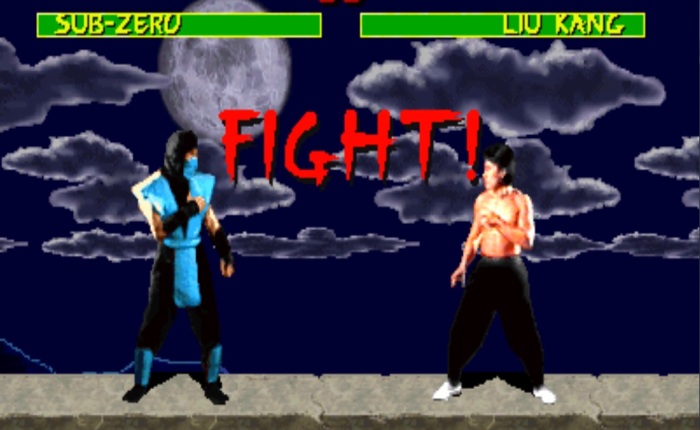
Also Nick gives Mortal Kombat a 5/5 rating so as to use their image. It’s a review! Of Mortal Kombat! Surprise! 


Affecting Realism in Dialogue

Affecting Realism in Dialogue

People talk funny. I’m considering ending this post right here.

But that wouldn’t be fair. Writing dialogue in fiction is a tricky little monkey because it wears probably the most hats out of any of the devices in your narrative tool kit. Before we go on, take a moment to appreciate the image of a tricky monkey trying on a lot of hats. Heh. Rad.

Dialogue needs to exposit the plot without being too obvious, represent the atmosphere of the setting, as well as indicate a character’s specific values. Instinctual solutions to this triple-headed problem are often, ehm, shitty.

Kind of in the same way every novice thesbian reads every character in a British accent, the writer’s most common pratfall is raising the dialogue to give it a touch of misplaced class. “Stilted dialogue,” is probably a phrase you’ve read in a book or movie review and refers to the dialogue being stiff, overly-prosaic and “unnaturally formal.” It’s an easily justified solution– “My character’s a class act”– but it commonly bores the reader to hell and back. Worse, it’ll show your ignorance of how Victorian age gentlefolk actually talked because, let’s face it, you don’t know from personal experience, you just watched Pride and Prejudice and thought that’d it look smart on paper. It doesn’t. It’s boring and stupid. Moving on.

The other direction is one I’m more likely to head myself: utilizing dialect. There’s some pratfalls here, too. The most obvious one is looking like a bigot. Writing, say, a Chinese character in broken English would probably earn you a lot of hate. Another danger is steeping the dialogue in so much slang that the meaning is unrecognizable. There are exceptions to this, of course (Anthony Burgess’s A Clockwork Orange, for example), but generally speaking you still want the reader to understand what’s being telegraphed. A third danger is similar to the stilts– which is an over reliance on the same dialect. I have this problem that I’ll end up injecting southern drawls into all of my stories, regardless of genre. I’m working on it. But I opt for this direction more often than not because dialect is a means of relaying attitude–and yes, sometimes that attitude is hoity-toity high class Bourgeois bullshit– reflective of the character saying the words.

Over explicative dialogue is also a bummer. I call them “information dumps.” It’s when a character breaks down the plot without nuance and spoon feeds the reader “the grand reveal.” Sometimes it’s unavoidable. For readability and logistical reasons, eventually a character needs to squeal. I don’t always handle this well myself but studying hardboiled detective fiction has offered a blunt solution– make the Macguffin of the story the information itself. Noir fiction achieves this by making the primary action of the novel a series of interviews rife with exposition in a way that seems natural to the needs of the primary character. There’s a suggestion there that applies to all genres– if you need to exposit some plot, enact an interrogation of some kind. Is it a perfect solution? Well, nothing’s gonna be, but as far as my money’s worth squeezing information out of a character tracks more naturally than unsolicited explanations for what’s going on.

Between the tasks of characterizing, expositing and reflecting the setting through dialogue is a golden opportunity to triple down on all three. It requires doing something rather unintuitive at first. Go off track. Instead of having a character simply stating their goal or the nature of their world (which I understand, sometimes ya gotta do), have them fixate momentarily on something non-sequitor. This loop around the immediate problem at hand provides a subtle glance at the setting while keying the reader into how a character thinks– while still participating with plot driven dialogue. Let me dummy up an example:

“Jess, we got to get goin’.”

“The flowers haven’t blossomed yet. Why haven’t the flowers blossomed yet, Jake?”

“Jess? We need to leave, now-like.”

In three short lines of dialogue we know that Jake is urgently concerned with the current setting. Maybe he’s a protecter type, maybe he’s just anxious, but he’s moving the story along. We know that Jess is perceptive, curious and introspective. We know that the flowers haven’t blossomed which makes us feel like the world that they inhabit has gone wrong. It goes from plot and setting to characterization and atmosphere and back to plot.

The reason why deviation coupled with dialect works as a means to express dialogue is that it’s how we naturally speak. We don’t necessarily write the way we talk– except for me and it’s weird to talk to me in person– but we should aim to come as close as we possibly can while still serving the purposes of dialogue. Dialect works because it grounds us to a particular lexicon and style. Deviation works because real life conversations often occur with both parties speaking around each other’s point (I hate to bring up Hills Like White Elephants again, but that’s the perfect example of this). How many times have you yourself brought up something entirely off topic in order to express your own interests? If you can find a way to instill that sentiment while preserving the alternative talking points (and excise the social obligations of “I’m sorry, this is off topic, but…”) while still sharing a conversation that explicates, characterizes, and reflects atmosphere, you might just make your piece feel a little bit more real.  And a spoonful of realism makes the plot go down that much easier.

Fuck stilts.


Exploring the Novel

Exploring the Novel

I hear it all the time: “Pierre, you’re such an interesting-looking creature, why don’t you pursue an acting career as a bent-faced, chain-smoking gambler in the upcoming Gun Shooty Bang Robot Boom reboot?”

And I always say, “Naw, babe. I love novels too much.”

And I do. A lot of people do. You ask people who don’t even read what their favorite book is and they’ll still tell you a couple of novels that have stuck with them over the years. So let’s talk about novels. More importantly why novels are, specifically, so important to the human experience? Maybe how.

By and large, people will read a novel once and only once. There are exceptions to the rule, but it’s different from, say, re-watching your favorite films or rediscovering an album from high school that friggin’ Jocelyn burned for you. Songs and scenes might get stuck in your head but it’s hard to capture in any directly relatable way what exactly got you with your favorite book, isn’t it? It’s less about the isolated moments that are so easily defined in music and film and more about the experience itself. To quote Ralph Waldo Emerson, “I cannot remember the books I’ve read any more than the meals I have eaten; even so, they have made me.”

What sets novels apart from anything else is the participation of the audience to help create what’s being seen, said, smelled… it’s a sensory illusion that the reader, on some level, hypnotizes themselves to believe is a felt, interior reality– if the writer did their job right. It’s a collusion between the two to create the suspension of disbelief. And unlike other art forms, it requires active participation.

(Which isn’t to say that film and music are solely passive experiences– it’s just that reading cannot be so.)

That intermingling of minds has always fascinated me. There’s a strange intimacy there between the author and reader that isn’t experienced elsewhere. Films have a lot of hands that touch the project– and while that is a remarkable thing of itself, that a collaboration of people came together to create something potentially beautiful– it only takes a producer’s (or an actor’s, or a budget’s) soiled fingers to spoil the whole pot of soup. When it’s a singular vision (editors notwithstanding) conveyed directly to the reader, the experience becomes thinking with another person’s brain. This is likely why reading novels makes you a more empathetic person.

That author-reader relationship is only possible through the design of the novel. It’s strange to think about novels as technology, but in the historical context of formatting of stories, novels are sleeker and more easily digestible in its modern form than epic poems or the travelogues that birthed them. There’s no baby fat of repetition for repetition’s sake (like you see in fairy tales) or the loose skin of extraneous oration that bogs down Greek narratives.

While the rule of threes has been commonplace for centuries, the novel perfected the three act structure by shaving it down to its base components. I don’t think it’s a coincidence that the novel was developed concurrently with the re-popularization of the triptych in western culture during the 1500’s. The Japanese invented the novel at least a good 300 years prior— and, not coincidentally, had been enjoying cohesive scroll ink paintings for at least a 100 years before that. Classical painting is emotionally and intellectually stimulating but is still more sensed through the lens of the viewer. Even with the triptych’s cohesive storytelling ability, a direct means of story remains elusive. That’s where the novel comes in as a continuation of that tradition– able to paint a picture in the reader’s mind and then able to explain the painting.

Speaking of the 1500’s, it’s also not a coincidence that the novel technology is also concurrent with the spread of literacy. Once a privilege held only by clergy and bards, the ability to read leaked out from the clouds above and pissed on all us sinners in a baptism of critical thinking. Without an interpreter, individuals were given the means of direct processing of written content. The result, of course, was an explosion of experimental writing (aaaand institutional upheaval), as well as a certain power regained by the common person: the ability to read and write your own stories. As much as the newborn readers found a sense of individualism with this new privilege, so did the authors– and it’s on that mental platform on which this medium was able to speak from the perspective of an individual and reach people on a personally affecting level, despite that thousands of people were reading the exact same content.

Now you might think I’ve forgotten about poetry. So what about poetry? Didn’t it have the same bloom along with the democratization of literacy? Sure did. I’m not talking shit. It’s just a different, more ancient, technology. My understanding is that poetry is the perfect distillation of emotion and moments into words. If the poet has done their job right. Poetry can be wonderful. But to me it often feels voyeuristic into the mind of the poet and the poet alone. The audience didn’t get there themselves. A journey’s missing. The crystalized truth within the poem often feels like an ill-gotten treasure.

So why obscure the feeling with arcane logic when you could just tell the reader what’s actually happening?

Some of the most powerful fiction I’ve ever read has been a short story. Still, I struggle to engage with a lot of it. Ideally, a short story identifies the moment before a life-changing event in a character’s life, not the moment itself. One of my all-time favorites is Jodi Angel’s A Good Deuce (Tin House Summer Reading 2011, issue #48) which takes place after the narrator’s mother has died from an overdose and ends right before the narrator has sex with an older woman in a car in an overtly oedipal exorcism of the tragedy. This is damn near as perfect of a short story as you can get– but it might’ve been untenable as a part of a full novel. The whole story has already been implied and would feel lopsided in the frame of a different story.

But more often, there’s the opposite problem. Short stories have the general policy of “you get what you get,” and often have the shortcoming of ending just a little too soon. In “Trouble Is My Business,” by Raymond Chandler, everything gets wrapped up just as the characters are beginning to flesh out. I didn’t feel cheated, necessarily, as I felt like the payoff was rushed and, as a reader, that I didn’t earn it. (It’s not unlike that Rick and Morty true crime spoof.)

Like a good (or bad) psychedelic experience, the books you read change you. Feel free to disagree, but I’ll forever maintain that novels are the most effective devices for changing you for the better.

Tale as Old as Time

Tale as Old as Time

I haven’t seen the remake of Beauty and the Beast. Not for any moralistic reasons (although if there was one, it’d be that it’s not gay enough) but because movies are expensive until they settle into the more financially accessible venues of second-run theaters.

But I will say that Beauty and the Beast is my favorite non-The Great Mouse Detective animated film Disney has produced. While The Little Mermaid has perhaps the most perfectly paced story of the 90’s Disney Renaissance (because I guess we just throw that word now like rice at a wedding), it was Beauty that fully captured a full spectrum of perspectives– think how many songs are actually sung by Belle? Or the Beast? The animated film is fully fleshed out emotionally by outsiders examining the simple love plot at the heart of the story.

That’s the immediate reason why I’d say Beauty is superior to a lot of other Disney films, but there’s some folkloric magic inside that movie that isn’t so apparent– and it’s an element that connects it to Disney’s earlier ventures of animating established fairy tales:

Beauty and the Beast is Blue Beard.

For all you cultureless heathens out there, Blue Beard is the fairy tale of a young woman who marries a count or whatever. He’s a rich dude with a blue beard who’s had many wives over the years, all of whom have disappeared under rather dubious circumstances.

Fun fact: while blue beards existed in the way-way back, red flags did not.

Anywhatsit, this gal is given everything she desires– nice clothes, good food, bitchin’ jewelry, radical skateboarding half-pipes, you name it– with the one exception that she couldn’t enter this one door. After some filler, you better know that she opens that door. Inside is all of the dismembered corpses of Blue Beard’s former spouses. Blue Beard catches her in the act and draws his sword, about to slice his young wife into skirt steak– but oh! She protests! And depending on the version either her brother or some strapping young knight hears her screaming and comes along and stabs Blue Beard until he’s nothing but pudding. It’s a happy, gruesome ending.

The Disney version is arguably a little different.

The basic buildings blocks are all still there though: a pretty, possibly naïve, young girl is imprisoned in a castle (I’m not even going to make the grim comparison with marriage here), she’s given every comfort personified furniture can give her (“Be… our… GUEST…”), but she’s forbidden to enter a particular room (and when she does, Big Bad Beastie Boy flies into a rage. Just not a decapitation-happy one).

The deviations from the fairy tale are actually pretty clever: the forbidden room doesn’t contain a bunch of corpses, but a wilting magical rose symbolic of Beast Bro’s incapability to love. And there’s some overlap there with the rudimentary tale– a room full of dead wives sends a pretty direct message that Blue Beard has the wrong idea of what it’s like to commit. But the greater idea is that this is about control– both Blue Beard and Beasty Bitty Boom Boom are angry because a woman went against their wishes. The former reacts violently, whereas the latter learns how to let go– ultimately letting Belle leave the castle.

Aww.

The shining knight in armor also turns out to be a huge piece of douche-gristle who assumes the maiden needs saving and attempts to kill the monster despite the lady’s protestations. It’s just a great piece of contextual fairy tale irony. Gaston dies a fairly gruesome death (for a kid’s movie) while the monster gets the girl. That’d be like if Grendel killed Beowulf and hooked up with a Scandinavian princess on Beowulf’s grave.

It’s also a good study of how to take basic storytelling principles and turn them on their head. Fairytales have rules to them– they had to, because they were a spoken tradition sang drunkenly at parties. Rules are a lot easier to remember than details (which you can just make up on the spot) and Beauty‘s an excellent example of changing around a few details to better suit the story for a modern audience, while keeping the primary code intact.

And you might be saying, “The Little Mermaid was a Hans Christian Anderson fairy tale and they changed a lot of stuff!”

To which I would say, “While that is true, Anderson was more of a Victorian-aged author of short-stories that resembled fairy tales, but didn’t have quite the spoken traditionalism behind his work– which isn’t a bad thing. He did what Disney did. I would also like to mention that Anderson’s The Little Mermaid culminates in the mermaid committing suicide and, while that’s totally metal for a story about fish-women, there wasn’t any room for Anderson’s knack for sadism during Bush’s America. Now please leave, Straw Man, I’m sure you have to go startle some birds off a cornfield.”

Beauty and the Beast is just a solid example of spinning an old story in a way that’s easily digestible. It’s able to sublimate Blue Beard‘s more gruesome details with romantic flourishes such that it becomes something almost unrecognizable from it’s predecessor. And that’s essentially the goal of writing fiction, isn’t it? Finding opportunities for novelty in a story that’s been told a million times over? In that way, despite being a story about some hot nerd nursing a burning loin for a bear-demon, Beauty and the Beast succeeds creatively.

Could be gayer, though.


S-Town and Tangential Storytelling

S-Town and Tangential Storytelling

Spoiler alert for the podcast S-Town. I ruin it.

So if you party like I do then you’ve already binged the entirety of NPR’s S-Town podcast on a Saturday night while sharing a fifth of cheap Scotch with your best friend, a crayon drawing of a sad woman on a napkin.

Anyway.

S-Town is a fantastic journey revolving around the troubled redneck genius John B. McClemore– and during those revolutions, a layer from the small town in rural Alabama is shaved off and inspected thoroughly, revealing that every inch of this place has John’s DNA somehow embedded into it, even well after his suicide. It’s a mind-blowing piece of investigative, empathetic journalism.

And there’s a popular theory that John himself “authored” the narrative of this story from the very beginning and there’s a lot of tempting evidence that this is the case. Too many metaphors make too much sense. You have the “null set” of the maze which not only summarizes John’s philosophy on his own life (there’s no solution and yet you’re trapped in an experience of convoluted twists and turns and frustrations) but also that of his thoughts on climate change (no solution to the biggest problems that plague us)– the pessimism is almost redundant. There’s never any solution, just problems, of which John bitches about constantly. Brian Reed even suspects that John had set up the “null-set” on purpose early on in the series. And that carries an implicative weight to the other puzzles John has proposed: namely, the murder that wasn’t a murder and his hidden stashes of gold that might not actually be buried. Problems without solutions. Wild goose chases. Geese chases? Never mind.

There are other metaphors, of course. One of the most striking is how John gilds a dime to give to Brian using potassium cyanide. He ingests the same chemical later to kill himself. The beautifully grim metaphor, if there is one, is that John was symbolically turned to gold on the inside. (Sidebar: it could very well be that this is the metaphorical gold that John has sent Travis to look for– not material wealth, but the appreciation of their friendship once he’s departed. But that rings a little too smug and cold, even for John. It sounds too much like every high-schooler’s threat “you’ll miss me when I’m gone.”) The gold metaphor comes full circle when it’s revealed that John’s other preferred gilding practices likely incurred gradually detrimental brain damage similar to the Mad Hatter’s disease.

So did John just use Brian Reed to enact a dramatic suicide note? My take? Not really. You’d have to discount the tireless work Brian and his team did to find this extremely personal narrative, slogging through hundreds of hours of audio. S-Town is a testament to how important editing is– how essential scene selection can be for an emotional payoff. John was a man who rambled, rambled coherently maybe, but shot off from one subject to the next until it inevitably spiraled into climate change and the doom of his shit town, Woodstock.

John also thought in metaphorical concepts. He’s a clock-fixer-upper, it makes sense that he could create complicated stories with people acting like the cogs that turn against each other… but again I feel like that’s a disservice to the amount of work put into this thing and the narrative constraint they put upon it. S-Town could have been many things, if based on John’s metaphors alone. But everyone involved in production was smart about it and they made it into a journalistic novel not unlike Truman Capote’s In Cold Blood.

And I salute them for a storytelling strategy that often goes unappreciated– that of constant deviation and tangential leaps. I think, because John was who he was, this was almost inevitable. Well, that and the fact that the first story (the non-murder) would have rang kind of flat if not for Reed’s post-mortem investigation into the intrigues of Woodstock.

If you think about it, the narrative goes from hanging out with John (noting his pierced nipples), to the murder investigation, to the suicide, to the familial troubles of John’s family which branches off into two distinct parallel perspectives (Travis and Rita, the former of which is now searching for gold, the latter of which tried to get those nipple rings as a keepsake from the coroner), both of which leading towards contacting the lawyer and town clerk (Faye), which opens a lot of questions which leads towards John’s perhaps most intimate friend and the explanation of the “flagellation” ritual of piercing his nipples repeatedly.  It could be that I’m bad at summarizing things, but I think I got the basic story down.

I’m using the nipple ring motif because it’s something that first appears as a random, almost unnecessary detail that keeps returning as a slightly more relevant (even contentious) detail before the symbolic weight of the piercings are finally revealed. It’s also the perfect example of a little quirk that binds two disparate narratives together. Of all the legal conflicts between Travis and Rita, it’s the nipple rings that apparently affect both on a solely emotional level. And for Travis, the explanation brought us back to John’s workshop, practicing their “Church” service, one of the last images we have of John in S-Town‘s narrative. It initially came off as thematically forced to thread the story along before Reed and his team finally let the last Tetris block fall into place.

The art of tangential storytelling is that if you take enough left turns, you’ll eventually end up where you started, but, like all stories, you’ll have gained perspective. By the end of S-Town we’ve gained the perspectives of many people who’ve interacted with John, but in a sad way, once the series is over, we’re back to a world where John doesn’t exist and are forced to ask the question, am I the better for knowing this man? S-Town (or Woodstock), too, like the gloomy protagonist always insists, is more or less the same town it always was, minus an eccentric that many of the townsfolk preferred not to know. Are they the better for having this series released?

The latter is the kind of question I can’t answer definitively. I think exploitation was avoided as much as it could’ve been. Not that it might matter to the people of Woodstock. “Fuck it,” is the motto for telling everything upfront, after all. In that, I feel, there is some elemental truth of honesty. The tattoo artist is upfront about his racism and Reed, while hiding the fact that he’s married to a black woman and is Jewish, accepts that and moves on to other topics of discussion. He does it without necessarily demonizing the guy. That was a lateral move of empathy, uncomfortable though it may have been, on Reed’s part to keep on digging for the story– and he found it (summarily: John would get a tattoo every time the shop was in the red to give them enough business to get ’em back to black). Effectively Reed piloted a narrative into a crash-landing in shark-infested waters and made the story about the sharks and where they swim. But they’re not as scary as you’ve come to believe. That’s the kind of opportunity that this kind of story mechanic allows for.

The structure of tangential storytelling is more intuitive than you might think. After all, the recipe for the second act of a hardboiled detective novel or police procedural TV show is rooted in the act of interviewing people. This is what translates so elegantly to the podcast format of S-Town– Reed acts as detective running down leads on his deceased friend and picking up common threads between seemingly unrelated perspectives. We see those interactions recorded as they happen and we love it. It’s why you’ll remember scenes from All the President’s Men if not the actual newspaper article that broke Watergate. Just like John’s riddle of where he left his gold, it’s the journey that’s more important than the outcome.

Which might be trite but nonetheless true.

I suppose it’s because that journey uses every tangent as a discursive opportunity to explore an element of John’s life or otherwise his impact of the people he left behind– and their lives in S-Town. To bring up my favorite book on earth,  The Savage Detectives, Roberto Bolaño employs the extreme method of using 52 narrators to account for the actions and whereabouts of two scummy poets over the course of several years. The plot of the novel is entirely implicative, obscured by the dozens of stories people tell, not only about the poets, but about their own secrets, troubles, impulses, mental illnesses, historical fascinations and racial biases. It tells of the evasive duo, but not without letting in the reader about their own life. Likewise, John B. McClemore is sort of a magnet thrown into a mine. He’s always at the center of things, but everything/one that sticks to him is also fascinating.

Which nullifies the “null-set” paradigm of reading S-Town. At least on a cynical level– I doubt that John’s dream of a suicide note would include intimate details about his rhinoceros-skinned nipples. It includes everybody he’s known, and while he’s had his own time to devise his time on earth, it’s the people that he’s interacted with that get to spin his legend. And everyone’s got a different outlook on the guy. He’s been many things. But there are common threads of kindness, pettiness, embarrassment, cowardice, success and failure…

And through these many lenses we get the character of John from the outside looking inward.


Big Bang: Action and Reaction

Big Bang: Action and Reaction

My brother recently posted a link to the wiki page of Reflexivity, which is a pretty fascinating social concept if you want to get into it. In short:

Reflexivity refers to circular relationships between cause and effect. A reflexive relationship is bidirectional with both the cause and the effect affecting one another in a relationship in which neither can be assigned as causes or effects.

It made me reflect on why a lot of my earlier writing was stagnant and I boiled it down to the fact that the story itself  wouldn’t move. Characters would respond to their own agendas, instead of each other’s. Or worse, they wouldn’t do anything at all, just idly soaking up the setting I’d provided until something dramatic happened to them. The story would muddle into itself, pooling into an incomprehensible, too-clever-for-its-own-good gooey mess.

The thing I always try to remind myself is to root the story in action. Simple motto, sure, but it’s a surprisingly non-instinctual one for those of us who shoved our brains into the English major– you spend more time figuring out what something means instead of why it works.

By bringing everything down to the world of action, the story becomes clearer because it doesn’t get bogged down in descriptive language or exposition– you can always fill in the stylistic flourishes later. It also forces the writer to respond to each action with a reaction from another character in play– or the setting itself (man punches wall, light fixture falls on his head)– and then forces the instigator to respond to the situation they’ve created.

Which provides an excellent opportunity for characterization. Actions, after all, speak louder than words, even if they’re subtle. Compare “Mr. Beemouth looked dismissive…” with “Mr. Beemouth cleaned his ear with his pinky finger and examined it while Ms. Rawwwwwk spoke.”

Some famous schmuck said a long time ago that the hardest part of writing fiction is making the character leave the room. That’s a question of motivation which is a tricky thing to figure out in the drafting stages. Thinking in terms of action makes that problem a little easier to solve. What are they responding to? Personally, I’m a fan of pro-active characters, idiot savants, who create the problem themselves and complicate it by attempting to solve it (see: Fish Fox Boys) or characters like Sam Spade or Phillip Marlowe, who complicate the story by aggressively hammering themselves into it and then catching what shakes loose in the chaos (see: Muddy Sunset).

To bring up a modern filmic example of muddied and clear action sequences, look no further than the final fight scenes of The Avengers and Captain America: Civil War. In The Avengers, the scene becomes confusing the moment the army of alien invaders come on stage. The action becomes hard to track– the plane takes a hit from a passing enemy and has to crash land, Iron man shoots a bunch of missiles and a bunch of the aliens explode, and then does more of the same, yada yada yada… it’s hard to describe, in part because of modern shooting and editing practices, but I feel it’s because the actual cause and effect of the battle becomes obscured in its vainglorious attempt to overwhelm the audience (which isn’t to say that large-scale battle scenes are worthless– Kurosawa figured out how to lineate the sequences such that a scene could be personal while still pulling off gigantic fight scenes).

You compare that to the final fight scene in Civil War? Shiiiieeeet. Every blow is accounted for. There’s more emotional weight to it and while part of that is the viewer’s internal conflict watching two beloved characters beat the Christ out of each other, that weight is telegraphed by pure, violent action– with almost no atmosphere or dialogue. It’s just action met with reaction, stripped down the the bare essentials. And it tells a better story, I think, because it follows a logical sequence.

Novelty: Jazz and Chess

Novelty: Jazz and Chess

“_____ is like chess” is the laziest simile there is in the English language. Supposedly, everything is like chess, right? Relationships, raising dogs, building roads, checkers, sex, and building Gundam models. The message is that something requires strategy. Like chess.

Writing is like chess for a different, less contrived reason. Radiolab did an episode a while back about the possible moves in chess. Since the 1600’s chess moves and positions have been recorded culminating into a huuuuge Russian library of games. There are hundreds of thousands of moves. It went online and expanded further. They describe it as a galaxy of possibilities. As a result, chess became an exercise of rote moves and countermoves– essentially prescribing the entire game before it starts. But as the episode points out, as certain games progress, the number of games a move has appeared gets smaller and smaller until a move occurs that has never occurred in history. They call it the Novelty and it’s supposed to be very exciting.

I bring this up because the question of originality comes up a lot in writing. When a piece of work is called “cliché” or “hackneyed” or “trite,” it’s usually a sign of laziness of the writer, right? After all, they just took the concept of X and dumped it into Y.

And maybe that’s unfair. It’s a disappointing experience, sure, but all work is derivative. I’m not defending plagiarism, which is a problem which should be dealt with by means of shovel-punching, but I’m saying once an idea works, the only way to go forward is to try deviations of that idea a million times over.

The Story Grid Podcast got into this a little bit when they discussed how every pitch in the 90s was basically “It’s Die Hard… wait for it… INSIDE OF A WHALE. WhhhhaaaaOOOOAAAAA!!!” It’s how memes work. You make a joke and then you drag it through every possible version until someone makes the best one and then wins some short-lived validation.

Better example: Cowboy Bebop. Jazz, noir, western, and sci-fi were all established genres before 1998. That gem had the audacity to combine all of those elements into something no one had ever scene before. And guess what? Four years later, that recipe was copied and repackaged as Firefly.  Those two television programs are undeniably their own thing, despite sharing the same DNA.

There’s a whole website dedicated to cataloguing the conceits that occur repeatedly in pop culture. And yet, new content, even if it mimics previous works, can bring us new experiences.

It’s almost impossible not to make a written piece your own thing, even if you’re “painting by numbers.” David Wong had a quote on this that I couldn’t find, so here’s a similar one about how the personality of a writer inevitably bleeds into the work:

You can’t write fiction that’s not at least a little bit biographical, since you’re writing it from inside your own head and filtering everything through your own experiences. Even if you aren’t directly recreating scenes from your own childhood or whatever, you’re still writing about your own anxieties and hopes and it’s all filtered through your own view of the world.

And that’s a great thing. In a world of an ever expanding ocean of literature with the rise of self-publishing, it’s heartening to recognize that each book, if written in earnest, has at the very least personal value in the pages. That novelty is something that can still be attained despite the flood of content. I once read a book by an indie author and it was laughably terrible– but I have to give the writer credit that I had never read a hardboiled detective novel in which the main character sings karaoke and gets laid instead of solving the crime.

The way that originality seems to work is by slogging through tropes and clichés and turning them on their heads when you see the opportunity– it has been explained to me by very smart people that this technique is why Shakespeare was somewhat popular in his own time. And there’s a lesson there: you play off the expectations of the reader/audience with the cliché and then subvert the cliché, creating a pleasurable irony.

That’s how jazz itself works, right? If you’re familiar with the complexities of musical theory, you can improvise on top of it.

It might sound like I’m justifying dubious writing practices, but remember this: books are organized by genre and sold by keywords and metadata. Inevitably, you’re going to have to study the obligations of that genre and the various recognizable tropes within basic storytelling. And then you’re going to contribute your own variation.

Because we don’t stand on the shoulders of giants. It’s more like a Yertle the Turtle situation.


Black Box: The Art of Restraint

Black Box: The Art of Restraint

There’s a concept in illustration called artistic restraint– at least, that’s what I call it. It’s knowing when to stop adding texture and detail before you over-complicate the image and make it harder for the eye to engage with it. The idea is that the viewer will fill in the missing pieces subconsciously. The full image is implied by the artist’s “incomplete” rendering.

This applies to fiction and I’m not talking about brevity, either. I’m talking about the pacing of information, because in a lot of ways, the best examples are those that are technically “overly-complete,” in its exposition, while burying the lead– the grander narrative, so to speak– under layers of storytelling .

The classic example of this is Hemingway’s “Hills Like White Elephants,” wherein a couple has an intense conversation without ever directly acknowledging the subject of debate. One of my professors once told me that this story was a failure, in that no one understood what the story was actually about until Hemingway gave it away in an interview. I kind of agree to an extent (anyone who tells you what that story is about was 99% likely to have been told themselves. It’s not exactly evident in the writing.) but I also appreciate that all readers understand that something bigger is going on in this little exchange.

Easier discussed examples are found in the horror genre. I’ve mentioned before that H.P. Lovecraft loves to obfuscate the true horrors of his stories with psychosis, doubt, and scientific reasoning, while only allowing a mere, vague glimpse of the monster before the story ends. His contemporaries, such as John Carpenter, do likewise– you never see what the Thing actually looks like, just the perversion of its replicated host. The doubt and conflict is born out of the fact that anybody could be the Thing.

A modern novel that understands informational control well is Bird Box by Josh Malerman. The premise is this: there are “somethings” floating around outside and if you see one of them, you go insane and kill yourself and those around you. The entire book is therefor written, essentially, blind whenever the characters are not inside of a boarded up house– which also creates a sense of blindness to the outside world, despite the sensory details of a home. The amount of information as to what the hell is happening is minimal, and experienced minimally. As such, there’s a pervading sense of paranoia and claustrophobia throughout the entire book, expressed through these sensory limitations. Also, the climax contains one of the most appalling things that has ever entered my brain.

It Follows takes this concept and makes it one of its primary themes. The horror is only experienced by the protagonist as they’re the only person who can see the monster in pursuit. Furthermore, it’s relevant only to their life, taking on the image of someone they know personally. Essentially, the cursed person’s experience of the horror is filled in by their own subconscious– generally with the broad strokes of Freudian of sexual formation (Jay first sees an elderly naked woman, possibly her grandmother; Greg sees his own mom in a night gown; Hugh claims to see a girl in a yellow dress). The horror experienced is a black box that no other character can access. What’s excellent about It Follows is that it spends just as much time with its secondary characters, usually slasher-fodder, and actually develops them into a unit of friends concerned about the protagonist undergoing a difficult time that they don’t understand– because they don’t have the information that the protagonist has. As much as you sympathize with the main character’s isolation, because you’ve been there, you also empathize with the others’, because you’ve been there today.

Information becomes currency in stories. Look at Silence of the Lambs and pay attention to what information does. The main storyline unfolds like a procedural tracking down Buffalo Bill until Hannibal Lector comes onto the scene. He understands that information is powerful. He delivers information about Jame Gumb to thread the narrative along for what? Information about Clarice Starling. Specifically, personal, traumatizing information about Clarice Starling’s childhood. Quid quo pro. It does something to a reader, having to face a character’s darkest memories. The reader, along with Clarice, has to access their own personal account of darkness and attach the weight of their own traumas to hers. But the character of Hannibal Lector does something even more insidious– he gets the reader to goddamn like him. You do what Crawford always warned Clarice about: you forget what he is. So when he finally bursts out of his cell via the grisliest means necessary, you’re suddenly stuck between cheering him on and personal betrayal accompanied with self-disgust.

It’s called a psychological thriller for a reason.

The thing that you carry away isn’t necessarily the way that the story ends, but how it affected you. Silence of the Lambs is effective because it’s main plot line is almost a red herring for the more subtle horror of Lector accessing Starling’s/your mind. Buffalo Bill is disturbing. Hannibal Lector is seductive. Silence does this by foiling Lector with Crawford, both manipulative men. The story controls its flow of information so carefully, that while you, along with Starling, are wary of Crawford who remains stoic, vague and unyielding of his intentions, you buy into Lector, who’s smart, polite and generous with his knowledge. It makes Starling, and you by extension, despite everything in her power to remain at the head of the curve, naive. 

The Black Mirror episodes, “Shut Up and Dance” and “White Bear” execute this perfectly by stringing along an increasingly cruel set of circumstances for the main character, encouraging our sympathy the entire time, before dropping the curtain and revealing who the main characters really are–a simple revelation that makes us question whether or not our sympathy was deserved. It puts the entire narrative we were just told into another light with a single line of information. That’s the power of limited perspective.

In the batshit crazy House of Leaves the information we are given is… a lot to take in. The worst but only way I can describe it: this is a book about a guy who’s writing about a book he found written by a different guy about a film a third guy made about his house that doesn’t make sense. And that’s just scratching the surface.  I think I’ve mentioned before that reading this book in public makes you look crazy– you have to turn it around to read all of the annotations, flipping through several pages, back and forth, as there are annotations to annotations, forcing you to reference the index in the back and you journey through the narrative only to find that it folds into itself endlessly. And then, if you’ve done the homework, solved the puzzles, educated yourself about architecture, documentary film-making, and cryptology… the real story emerges like a 3D painting.

And it happens weeks later after finishing the fucking thing. It’s a study in forming broad strokes via intricate design.

I know what you’re thinking: how does this relate to True Detective? Funny you should ask because I was just about to go there, you pidgeon-toed, gawking ratfink. Hardboiled noir fiction runs on the engine of gathering information about a crime or infidelity. Usually this is done with a progression of interviews, voyeurism, and clever deceits. Like all stories, it becomes complex and then it simplifies. Which you have in True Detective, expressed as a buddy cop procedural. Within that basic structure, you have the narrative device of flashbacks, contextual to the interviews of Cohle and Hart. It’s a simple thing to point out, but the fact that you see these guys as ruined, possibly insane old men makes you wonder what exactly the hell happened 18 years ago to warrant these changes.


True Detective also plays out as a horror story. There’s an encompassing feeling of dread threaded throughout the miniseries. But it’s only glanced at as reverberations in the “psychosphere,” mentioned by junkies, felt but never seen– the closest we come to seeing it is Cohle’s hallucination of the black star while he’s being choked out by Errol. Usually we see it in brief glimpses through Marty’s eyes– his daughter’s recreating a ritualistic murder scene with dolls, or the entropy of of a tasseled tiara stuck in a tree. Likewise, the protagonists never face the shadow society responsible for the historical murders in the area. They get Errol– which disappointed a lot of viewers but is thematically on point. Sticking with concrete leads brings them to a concrete, yet impotent conclusion and Cohle understands that the bigger, elusive (and allusive) culprits are still at large. Hart acknowledges their own limit of understanding by the consolation “We got our guy.” The story becomes complex in its information and then it simplifies, but the difference here is that there is still incomplete, complex, deliberately placed information that hasn’t been digested by the narrative, speaking of a much larger conspiracy that appears unconquerable.

All of this is to say that the most effective story you can tell is one that subtly asks the reader to tell themselves a story along with you. They’ll meet you halfway.


How Stanislaw Lem Writes Allegory

How Stanislaw Lem Writes Allegory

A friend of mine (Hey, Zane) lent me a book, The Cyberiad by Stanislaw Lem, because of its parallels to The Fish Fox BoysThe Cyberiad is a collection of somewhat related short stories concerning two inventors, Trurl and Klapaucious and nearly every story is an allegory for philosophical mind experiments, a political satire or a treatise on the human condition.

Unlike other allegorical writers, Lem’s approach is hilariously heavy handed and very intentional. From the Introduction by Christopher Priest:

“Lem […] always intended that these stories could be read on two levels […]. On the surface, they are amusing and intriguing, full of novelty and wordplay, but they also contain many moral ambiguities and reflect Lem’s personal philosophy.”

And apparently, he was very frustrated with his American contemporaries, and saw the sci-fi genre as a pulpy excuse to simply make beer money (with the notable exception of Philip K Dick, who repaid this appraise by reporting Lem to the FBI, barring him from the United States). On the topic, again from the Introduction:

“[…] he had a deeply sceptical [sic] attitude to commercial science fiction, and wrote an essay in which he described American writing as ‘ill thought out, poorly written, and interested more in adventure than ideas or new literary forms.'”

But Lem also understood that there was a practical reason for allegory: subversion. While I’ll make a subtle parable out of a Fish Fox Boys chapter to disguise a philosophical idea as absurdity on the sly, Lem had to get his works through state censors– work that contained agnostic, anti-Communistic messages. So, Lem shrouded his work– amusingly– in the sci-fi genre:

“[…] Lem was beginning to understand, that functionaries of a totalitarians state are never as intelligent as all that. Lem was starting to learn that the abstract metaphors of science fiction were one way of confounding the doltish Party men with their blue pencils. They simply lacked the subtlety, the imagination, to see past the words on the page.”

What’s particularly striking about that, is that the veil is relatively thin– but also happens to include a lot of fantastical technical jargon (that’s not a typo. Again, it is as fantastical as it is deeply technical which makes it, uhm, challenging to say the least) that pummels the reader with clever word play and puns, but is essentially non-essential to the plot. Lem himself even winks at this in “The Sixth Sally,” by creating a “Demon of the Second Kind,” which drowns a pirate demanding facts by writing down inconsequential information on an endless roll of ticker tape. (The mechanic of which, I believe, was explained to be literally grabbing facts out of stagnant air particles). This also seems to allude to Lem’s belief that “information technology drowns people in a glut of low-quality information,” which is not only a relevant and apt criticism of the Internet age, but is also particularly amusing to me as it illustrates my first college essay which drew parallels between Toqueville’s Democracy of America and the society influence of Facebook.

What’s that? Sorry, I couldn’t hear you. My Auto-Horn-A-Tootinator was screaming.

Back to The Cyberiad.

There’s a certain flippancy to this style. The characters have been given the god-like power to construct anything asked of them and the effect is one of aggressive anti-realism (which again is poked at in a story about how dragon’s don’t exist. I’m going to paraphrase it the best I can and apologize for any lapse in logic. The probability of a dragon’s existence is about 0%, the certainty of dragons not existing is about 100%, meaning that there is about a 100% chance of non-existing dragons, which increases the probability of dragons having had to have existed and as such a dragon materializes. My brain hurts.) which allows for a certain sense of freedom in his storytelling– in a crafted world where you can make anything happen, you can literally tackle everything as your subject matter. And Lem does. It’s a nice reminder that fiction doesn’t need to be necessarily formulaic to be interesting. It can just be interesting. And poignant.

In this anti-realism, there is a complete bucking and subversion of traditional storytelling conventions. Frame narrative, for example, gets a lot of abuse. In a story about Trurl inventing story telling machines for a king, the machines tell a story about Trurl telling a story to a second king, and in that story a dream-maker captures a third king in a long series of dreams, the ultimate being a dream of having a dream. I’m pretty sure there are actually more layers than that. Predates Inception by 45 years. Just saying.

Here’s what this can accomplish: by putting form on the back burner, one can more directly attack the subject of satire. In one episode, there’s a planet that’s pestered by a ship outside of its orbit who won’t leave. They launch a nuclear bomb at it to no avail. Trurl sails by on his rocket and instructs them to send a letter and wait for the response, only to respond with an assault of ceaseless forms and requests for licenses until the alien ship becomes frustrated to the point of leaving voluntarily. It’s the classic “pen > sword” parable, but in a more modern and global sense, it’s the crushing intimidation of bureaucracy, which might be favorable to nuclear annihilation– and then in a further sense, it illustrates how diminished the threat of the bomb is when it’s easily nullified, and how we resort to petty global politics to achieve our nation’s wants.

When Lem wants to discuss the callousness of Stalin’s Communism, he writes about The Multitudinous– a borg-like conglomeration of many, who feels nothing when scores of itself dies or becomes enslaved– and even commits those crimes against itself for its own amusement. When Lem wants to discuss religion, he invents a drug called Altruizine, which makes the users feel automatic empathy for those around them– which of course ends in alienation, murder, grief and voyeuristic sex crimes. When discussing existentialism, Lem writes a story about a robot who came into existence the pure happenstance of an airborne jug knocking some wires and body parts into a puddle of electrolytic fluid, spending eons to become conscious only to drown shortly after the realization of self-awareness. This versatility lends itself well to discussing human absurdity. I’ll quote from the final chapter of The Cyberiad, in which a robot disguises himself as a human to win over a robot princess and explains the daily habits of human life with rigid, robotic objectivity:

“In the morning, they wet themselves in clear water, pouring it upon their limbs as well as into their interiors, for this affords them pleasure. Afterwards, they walk to and fro in a fluid and undulating way, and they slush, and they slurp, and when anything grieves them, they palpitate, and salty water streams from their eyes, and when anything cheers them, they palpitate and hiccup, but their eyes remain relatively dry. And we call the wet palpitating weeping, and the dry– laughter.” (284)

Part of the reason why I found Stanislaw Lem so refreshing is that the aesthetics in modern sci-fi are so up its own ass, actual novelty in the storytelling has fallen by the wayside. There are exceptions, certainly, but the mainstream obsession is focused on how complete a certain world looks, not necessarily the message behind it. In The Cyberiad, all of the worlds are generally placed in a feudal, medieval setting, regardless of the planet, as if to say, after all of this technology and possibility, there hasn’t been much progression in human (and robotic) behavior.


But the thing that struck me as the most profound was Lem’s awareness of the function of story. Mirroring the sentiment of the first quote of this post, Trurl escapes certain death by creating storytelling machines that relay narratives that are compelling and perceptive of the nature of being. The awareness speaks of a deep understanding of how the human mind will resist foreign ideas, but might be accepting of the narrative vehicle in which the idea travels. To quote King Genius who allowed the constructor of the storytelling devices to live:

“Go then in Peace, my friend, and continue to hide your truths, too bitter for this world, in the guise of fairy tale and fable.” (243)

I’d be remiss if I didn’t mention the translator Michael Kandel, who, through some miracle was able to translate The Cyberiad into English and Daniel Mróz, whose illustrations added an extra whimsical flavor, featured in the header