True Detective Season 3 – A Return to Form amidst the Formless Void

True Detective Season 3 – A Return to Form amidst the Formless Void

Yeah, yeah. You’re all, “Hey, Pierre, are you shilling for HBO? Because this is the fourth consecutive post about HBO and the second about True Detective.”

Which I understand. But then you had to go too far, asking, “Are there spoilers?”

Shouldn’t you be somewhere not vaccinating your kids, you calamity? Of course there are spoilers. Jesus. 

Last Sunday aired the season finale of the third season of True Detective. It defied a lot of expectations– in a rewarding, thoughtful way– and for my money’s worth, was a touching capstone to a season full of loss and tenuous relationships. The finale challenges the viewer to clear away the bullshit distractions in life and, like Wayne Hays eventually does (in triplicate in his dementia-riddled brain), focus on what really matters.

The centerpiece of the series’ third entry is a family torn apart by tragedy. While I’m referring to the Purcells in particular, this could apply to just about every family represented in the season. Isabelle Hoyt’s obsession and then kidnapping of Julie Purcell is borne from the accident that robbed her of her own children, essentially filling a void by causing another. Despite bringing them together, the tragic case is what keeps Amelia and Wayne from trusting each other until they both decide to choose an actual life together, separate from the Purcell case. One could even say that the tragedy Wayne’s dementia is what strains his son to a near-breaking point and is potentially what has kept his daughter away for so long.

But this season spends a significant amount of time with the bereaved family central to the case. We see Tom Purcell destroyed, first seeking oblivion in a bottle, before filling it again with God. Roland West takes him on as an adopted brother of sorts– but we come to learn that he’s filling a void, too, one left from Hays choosing a transfer instead of besmirching his soon-to-be-wife’s journalistic integrity. Lucy Purcell also continues to self-destruct, but now armed with the information that she willingly sold Julie into a “better life,” her cratering lifestyle is a self-flagellation of sorts for silently condoning the accidental murder of her son, Will. The need for her to keep quiet leads to some outbursts and while, in retrospect, Lucy’s “fuck all” attitude might speak to a mother’s guilt alongside grieving agony, she makes a point when she calls out Amelia for being a tourist of her pain. Lucy and Tom are subject to scrutiny, cops and writers looking through their windows during the single-most devastating part of their lives. Lucy can’t cope, eventually dying from a hotshot delivered by Harris when it was apparent that she might come clean. Tom stops punishing himself and seeks to punish others– namely Dan O’brien (no, not one of the funniest persons of internet comedy) — before finally receiving the oblivion that he, in some ways, was seeking the entire time via rigged suicide.

That aspect of voyeurism is played directly back at the viewer, as it is towards Hays. The TV show within the TV show, True Criminal, scrutinizes Wayne Hays hoping to validate their theory of what happened– or otherwise hoping that he’ll contradict himself. The stakes are pretty high once you realize that Hays and West killed a man with the added tension that Hays doesn’t know where he is half the time. But True Criminal also serves up a scathing condemnation of our true-crime infused society. It’s as not heavy-handed as it could’ve been, as True Detective understands that its audience is into grim shit, but it’s also not a wrong assessment, given that Netflix recently released a docuseries about Ted Bundy, seemingly glorifying that misogynistic piece of shit. As much as this story is about the core characters letting go of their obsession with a case that doesn’t need to involve them, this is Pizzolatto telling you to give the family of a murder victim peace by, say, not redditing out theories or saying that a school shooting was staged or poking at the grave decades later.

Amelia characterizes the crime voyeur pretty perfectly. She’s plumbing her husband for details, plumbing other officers for details over promises of dinner, can’t let it go when she and Wayne meet Roland and his then-girlfriend for dinner, and puts it upon herself to interview Lucy, once and again. She’s called out, of course. By Lucy, by the black man with a white eye at her reading, by Lucy’s best friend. The difference between her and True Criminal, however, is that Amelia’s not out to condemn anyone. She humanizes the story of a tragedy the same way she humanizes Wayne– by establishing context and following up on that context, even if she “knows better by now.” It takes a true detective to marry a true detective, I suppose.

True Criminal also serves a pretty ingenious narrative function in that it drives the viewer’s expectations to believe that the Purcell case is tangentially related to Season One’s Yellow King and Season Two’s hippie-occult orgy. Personally, all of my theories centered around the possibility that it’s all connected, man. But it’s pretty satisfying to have Rust and Hart pop up on a computer monitor only to have all of that shit cleared away to discover that the mystery had been so much simpler than bureaucracy and the personal obsession of detectives, crime writers, and viewers thought.

Which all comes down to a reveal with Junious in 2015. Old men Hays and West put their unsteady guns upon him, himself an unsteady old man. While gardening. The moment’s tense but it also doesn’t let you forget that these are septuagenarians, even when they sit down to get the full story from him, Hays’s gun is on the table. And Junious spills.

It’s a classic noir trope set by Raymond Chandler– the end of the mystery culminates in the culprit spilling beans. By the end of the confession, Junious demands justice to kill him but our detectives give him the high hat, choosing instead to leave the man in groaning agony. It’s a complete juxtaposition to Woodard– the Native American Vietnam vet who cracked, not under police scrutiny, but under the system that fucked him with local racists attempting to lynch him  for no other crime than talking to children. He seeks retribution, and he gets it, only after making the decision Hays’s. Makes you think he was atoning for sins he wrought before he started shooting rednecks. He had the munitions. He had a plan. Yet, he made Hays pull the trigger.

We see a lot of “self-flagellation” in this season. After they torture and kill Harris, Roland West goes the Tom Purcell route of drinkin’ and causin’ ruckus. But this time, West wants to get the shit kicked out of him. And he provides a pseudo-comedic reason why. The motherfucker Wolverines out and gives more than he takes until a crowd overwhelms him. We see him weeping later in a gravel parking lot, without Tom, without Hays, without the girlfriend that Hays half-forgot. West seeks judgement, as Tom Purcell did. In that low point, a dog adopts him despite his fucked-up flaws, signifying why he prefers his family in a kennel while “passing time” in the country. Hays’s self-flagellation comes in the form of re-entering the Purcell case, via his late wife’s words. He puts himself on the rack of public opinion, agreeing to do the interview with True Criminal, and justifies it by saying that it’s helping him remember his life. Objectively, he’s only making more trouble.

But. There’s the annoying fact that the tracker Wayne “Purple” Hays is always right.  On the personal level, he’s right that Amelia is fucking with shit beyond her responsibility as a journalist, although the way in which he informs her of his opinion is pretty shitty. He’s right to defy the brass. He’s right to get an aged West on his side to complete the puzzle of the Purcell case, despite that he was wrong to force West to murder Harris. Mahershala Ali embodies Wayne Harris with a strident confidence and a reserved manner of speech– you get the sense that Hays always knows what he’s doing, even if he forgets why he’s doing it, and doesn’t feel the need to explain it.

Which brings us to what I think the core theme of season three to be. It’s summed up by “Amelia’s ghost” when she tells Hays to “know himself.” He might not remember where he is, but by God, he knows he’s there for a reason– hence waking up on Shoepick Lane and hence following up on Amelia’s ghost tip to determine whether or not Julie Purcell still lives. I like the AV Club’s take on that scene where it seems that Hays has a flickering notion of why he’s there and who this woman is before it disappears again– for the better. For all the tragedy wrapped up in the complications of dementia, the ability to forget is also Hays’s strength. Slowly, as the case is left to the past, Hays’s family finally comes together, including West, who has also let go of years of resentment and bitter loneliness to become a brother again to Hays. Since Hays is a tracker, a seeker of truth, forgetting the ending is the only way his story continues– or as Amelia ghost puts it, “the story goes on, healing itself.”

That last shot of Purple Hays in the jungle, his truest self, is going back into the tangle of his own mind. There, he’ll get lost in the Purcell case again, but he’ll also be with his wife, and make the same mistakes and loving commitments to her over and over again. But before he gets lost in the thicket, Hays looks directly at us, confident and wild, as if to say, “I know who I am. Who are you?”

If you are interested in reading some of my own noir fiction,  please check out Muddy MS_cover_smallSunset, available hereThe book follows PI Roy Delon as he untangles a web of corporate deceit in St. Louis, 1955. 
Game Theory (of Throne-Building)

Game Theory (of Throne-Building)

Now, you might be saying, “Buddy, two Thrones posts back to back? Wouldn’t it make more SEO sense to wait until the final season starts, instead of blowing your wad all up front?”

To which I reply, “Listen, buttnards, why don’t you keep your beak in your own pot of yogurt, you fuckin’ dumb door-holding fuckin’ oaf.”

…Because last time we talked about why Game of Thrones was so popular. We had a good time (we did. that is non-negotiable), although I didn’t talk about the actual series itself with any real depth. So what makes A Song of Ice and Fire so fuckin’ good when there are a bajillion similar fantasy novels shoveled out on the daily?

Make way for this post, everybody, get your your weird-ass-eerily-accurate-cosplaying persona on and let’s DIG… into our pockets and bring out our dodecal-sided die. That’s right, nerds, we’re gonna go into table-top RPGs and how they’ve shaped your favorite pervert-murder-dragon show on television.

There have been several unsung table-tops prior to Dungeons and Dragons but D&D is the one that stuck after its release in 1974– and much like its philosophical cousin, The Ouija Board, it ran a chill through the hardcore Christian, anti-satanist set. You know what D&D is. You’re hip.

As a goddamn king of nerds, it should come as no surprise that George RR Martin was (and apparently still is) an enthusiast. Apparently, several authors felt that Dungeons and Dragons served as a smelly basement boot camp for writing fiction. In the article previously linked, Ball University Assistant Professor Jennifer Grouling explains:

“D&D is completely in the imagination and the rules are flexible — you don’t have the same limitations” of fiction, or even of a programmed video game, she said. A novel is ultimately a finished thing, written, edited and published, its story set in stone. In D&D, the plot is always fluid; anything can happen.

I want you to pin that notion of story-fluidity behind your ear for a minute or two while we go into the fact that Martin himself ran a long, long campaign of a table-top RPG called Super World in the 80s. Beginning to realize that playing games was not a financially sustainable means of existing, Martin and his gang of hooligan-author friends did what anyone would do– they rewrote the rules of the game in such a way that their campaigns could be transcribed into novels and thereby published. It’s called Wild Cards and the whole story behind its origin is summed up pretty neatly here. Apparently, there’s a TV show in the works, offering hope to all us schlubby punks making art for our friends’ sake.

During this time, Martin went back and forth between trying to jumpstart a serious fiction career and writing for TV.  Suddenly, and forgive me if I’m wrong, he writes a scene he remembered from a dream he had. That’d be the Starks finding the Direwolves, the seed that’d become Ice and Fire. 

I say seed intentionally, because Martin sees himself as a gardener of stories. In his words:

I think there are two types of writers, the architects and the gardeners. The architects plan everything ahead of time, like an architect building a house. They know how many rooms are going to be in the house, what kind of roof they’re going to have, where the wires are going to run, what kind of plumbing there’s going to be. They have the whole thing designed and blueprinted out before they even nail the first board up. The gardeners dig a hole, drop in a seed and water it. They kind of know what seed it is, they know if planted a fantasy seed or mystery seed or whatever. But as the plant comes up and they water it, they don’t know how many branches it’s going to have, they find out as it grows. And I’m much more a gardener than an architect.

I’ll tell ya, architect and gardner are way better names than what the writing community at large has claimed to distinguish themselves as: plotters (which is self-explanatory) and pantsers (ugh, because one writes at the seat of their pants). It’s essentially the difference between folk who chart out every scene ahead of time and those who explore the words they’re writing while writing. Most authors are a mix of both. And I think it’s important to demystify Martin as some evil curmudgeon whose hiding the blueprints to your favorite dragon-murder-porno and instead see him as a person and an author who’s working on a project that means a lot to him.

It’s not that he doesn’t outline either, but it’s more accurate to say that he strategizes. Apparently an early outline married Tyrion and Arya together and Jaime became king after simply murdering everyone else (kind of like a evil run in a Bethesda game). But that would’ve robbed the story of Tyrion’s integrity of his sudden chastity with Sansa and Jaime’s turn from selfish, impetuous murder machine to self-reflective, all-around good amputee guy (*cough* excludingtheweirdrapeofhissisteronhisson’scorpse *cough*). That’s where the fluidity of viewing an epic fantasy from a bird’s eye view becomes advantageous–  you can see missteps before you make them and then correct course.

It’s why I think Martin views his own work as a table-top RPG that he’s playing with himself (and his audience). It’s documented that he’s a creative type who enjoys transferring table-top antics to words. It’s also documented that he writes an average of 350 words a day. But he has a lot, I’m speculating, a lot of notes and spends a lot, I’m speculating again, a lot of time strategizing.

Several authors I’ve come into contact with, fantasy or otherwise, have a bible of character and world information. It’s full of details. It’ll tell you that x character has brown eyes and z forest is deciduous and Lady HatchetVagina got her moniker ironically. And no doubt Martin has one as well– in fact he writes that shit into his books. Fuckin’ Ned Detective runs through the Baratheon Genealogy to find the golden-haired discrepancy that gets his goddamn clock ticked. There’s a whole chapter (maybe more? Clash of Kings is so big) where Jaime just pages through the White Book, describing all of the feats the White Cloak knights accomplished (some of which is narratively-super important, some not). Martin has definitely put the work in here. But understand, the work built upon itself while it was being written. World building expands. The fog of war dissipates as one moves in a direction. Things change as we look at them. 

The way it still strikes relevant is the fact that the dude spent his fantasy life in the company of other human-beings. If you’ll permit me a stark (heh) deviation to Roberto Bolaño and his (arguably) worst book,  Third Reich. It’s still, ugh, the best fiction out there. At least philosophically. The best I can try to explain what the book is about: a man goes on vacation to a Spanish beach, stays after his vacation (long after his girlfriend leaves), plays a table-top game of WWII, becomes obsessed with a local vagabond, the vagabond beats him at the game, dude fears that the guy is going to kill him and then the vagabond doesn’t kill him. While I’m fairly sure it’s a coded message to express Bolańo’s bisexuality, the novel maintains a descriptive handle on the game’s movements throughout (tediously so), while the main character wraps himself in isolation and paranoia with the exception of his homeless friend. It’s essentially a story about strategizing alone which is ultimately futile. War– like books, games, and art– requires engagement. In isolation the narrator, a German, forgets his own values and plays the Axis. The homeless guy, who is crazy but ultimately virtuous, plays the Allies and, despite being an amateur at the game, wins. This decimates and ultimately liberates the narrator.

From that deviation, I’ll take away two things. The first, as suggested above, is that Martin strategizes in response to other people. He understands the expectations and he knows how to subvert them almost perfectly (read: the definition of irony) which is what makes him such a bastard sometimes. The game he’s playing is against us and to quote Grouling again, “anything can happen,” in a game where “the rules are flexible.”

The second thing I’ll take away is the notion of values. One of my first posts on this site was about how you could use D&D to determine a character for your novel and it would be 10 times more believable than jotting down notes on a profile. Values override details every single time. Because details should serve to express value.

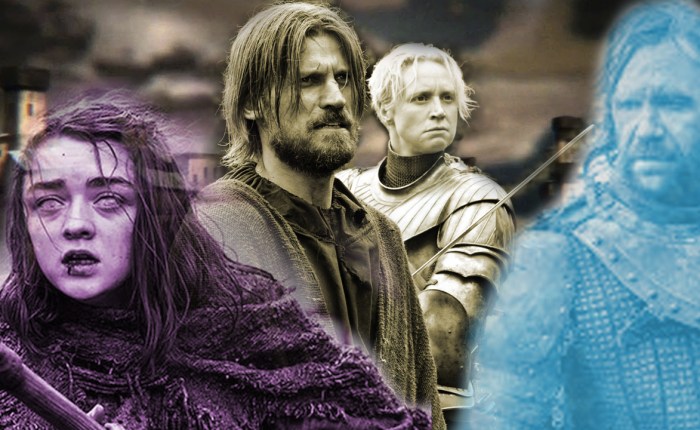
The character of the Hound (the best character! Fuck you! HooooyooooUUUUND!) maintains a certain value set throughout the books and show even though our first introduction to him is his ironic and cynical slaughtering of a young boy (the Han shot first of GoT). But his values become clear, slowly, as Martin is keen to show and not tell us. Lil Clegane’s main value is that he, in nearly every other happenstance, protects children (which makes his boy-slaughtering that much more of a sin). Later we find out why. Still, he protects the Child King Joffrey, then saves Sansa, before becoming Arya’s drunk and chicken-filled father-replacement. He’s a murderer who hates knights, doesn’t go out of his way to hurt women (equivalent to Westeros feminism, I guess?), and keeps the kiddies safe (save the one).

That’s why for three quarters of A Feast For Crows you’re heartbroken to learn that The Hound is raping and killing women and looting towns in the salt pans. Your expectations combat your understanding of the man you’ve begrudgingly come to respect and admire. The “oh-shit” moment happens in a turn of dialogue between Brienne and some old religious fucker who explains that it was Rorge, the noseless douche that kept harassing Arya “with a stick”, that had donned the Hound helm and used that brand recognition to pillage with his brigands. The godly man explains that the Hound died while a man who 100% resembles Sandor Clegane digs graves in the background. In the show, Sandor assists the building of a temple. In both cases it’s assumed that the death of The Hound is a symbolic path to reach forgiveness and atone for his sins through labor (the dorkier among you will nod and solemnly agree that this is the work of the Smith). Through the humiliation of physical work, The Hound transforms into Sandor Clegane, culminating in the scene in the televised series where Sandor attempts to properly bury the farmers that he himself had doomed to death by robbing them a few seasons earlier. He doesn’t seem unquieted by his past, but he continues to make a good effort to support those around him who are trying to make things better.

Just. Like. A dog.

That might be one of the most satisfying character arcs ever written and it works because the characters values remained the same but it required a few hundred pages and six seasons to finally realize them.

I don’t think I’m blowing any minds by saying that Ice and Fire is one big table-top experience. The intro to GoT literally resembles a game-map, complete with ticky-tacky toy-like renderings of the regions involved (wiiiiiith a game-chip circling the construction of Old Town). But it works effectively once transcribed to a literary experience because games have rules and players have values. 

That sentence alone explains the bulk of conflict in the series. Each house has a motto which serves as a rule. They also have repeated sayings which express values.

The Lannister motto is “Hear Me Roar,” while their repeated saying is “A Lannister always pay their debts.” Martin throws us another saying said about the Lannisters: “Lannisters lie.” Tyrion and Tywin play the game by the value of paying off debts to obtain loyalty and assure their own safety/regard. Cersei and Jaime (initially) play the game by the second value of deceit. But they all show their ferocity when push comes to shove and we see what happens when one value clashes against another. [insert “twang” foley]

The Boltons’ motto/rule is “Our Knives Are Sharp,” while their saying/value is “A naked man has few secrets; a flayed man none.” Roose plays by the rule, which is more in line with shady treaties and backstabbing, while Ramsey plays by the value of demonstrating cruelty. Playing by the rule changes the political landscape, while the value ultimately sinks the Bolton house into the grave.

And yes, you have the ever-memed Stark motto of “Winter is Coming,” and the saying “A Stark must always be in Winterfell.” Eddard died because he violated both. By heading south to deal with the politics of King’s Landing, he (albeit reluctantly) forsook his charge as steward of the northern defense against the wights/wildlings and brought Arya and Sansa along with him, leaving Robb alone to the Bolton’s manipulations and Bran, still comatose and crippled, to be strong-armed out of control of the municipality by Theon. The saying and value “There must always be a Stark in Winterfell” is a regional one, essentially saying that without a sense of nobility present, the north will fall to the cruelty of the likes of those fuckface Boltons or taken advantage of by the likes of those goddamn pirate Greyjoys. Currently, HBO-wise, it’s Jon Snow and Sansa upholding the motto and verse of the Starks, hence their survival.

I could go on, but I’m getting interrupted by this sound in the air… Do you hear that? That’s the sound of my virginity re-crystalizing. I learned what fuckin’ GURPS was for a free article on the internet. And I even held myself back from applying stats to characters (Tyrion: INT-8, STR-3; Jaime: INT-3, STR-9 then 2; Robb: INT-5, Str-8; Arya: INT-6, STLTH-9; Sam: INT-7, STR-1, STLTH-0, MGC-0, VIT-0; Melisdandre: MGC-9, TT-10; The Mountain: 10 everything except PSN RSTNC) because there’s a goddamn table top for Game of Thrones now. Cracked.com (before they sold to Scripps and Facebook leveraged the value of video content, essentially fucking up earning projections for every website you used to enjoy) made a video satirizing the likelihood of GoT making the tabletop circuit, leading to madness, betrayal and insanity.

I’m not mad about the RGP (I’LL GET DOWN OFF THIS LEDGE WHEN I GODDAMN FEEL LIKE IT), if it means ushering in another generation of innovative storytellers, but it strikes me as redundant. Martin’s JOB right now is to tell you how the game goes. You can pull a Third Reich and test your own values to try to make it go differently, but what’s the point when you could change the rules and write your own  damn thing?

Again, I’ll quote Grouling: “the plot is always fluid; anything can happen.”

The closest thing Manchot has to a fantasy epic at this time is a genre-bending comedy between Science Fiction and Fantasy featuring a trio of siblings bumbling through a happy-go-lucky nuclear wasteland. It’s called The Fish Fox Boys and you can start reading it here. ffb2_small

A Game of Thrones: Genre Smashing

A Game of Thrones: Genre Smashing

How the fuck did George R.R. Martin fool the general public into a near crack-addictive obsession with his Song of Ice and Fire?

Fantasy had always been this niche enterprise, an interest in which could get your ass kicked around a schoolyard. Even with the popularity of The Lord of the Rings and Harry Potter, your dedication to the series determined how big of an ugly nerd you’d be judged as: “Oh, you read the books? Us cool kids only saw the movies! And, yeah, and, and we were necking! Ask Gracie if I wasn’t ploughing that neck like some sex god!”

Fantasy was so niche that the other end of the spectrum held similar defense mechanisms if you weren’t into it enough: “Oh, you haven’t even read the Similarion? Nice try, n00b. Me and Gracie were necking while discussing Idril’s lineage, like, twenty minutes ago before you showed up with your Aragorn-loving ass.”

Yet everyone gets into Game of Thrones. My dad’s read the entire series and I’m pretty sure he has a religious allergy to chocolate milk. My friends are fiends for the latest episodes and they all have theories. The nicest, old, old, ladies that ride the bus with me are holding Fire & Blood.

I wanna know why this polarized genre has found such a universal audience. So let’s start with the aforementioned properties that brought fantasy into the mainstream, shall we?

Twenty two years ago, a down-on-her-luck gal named Joanne Murray (JK Rowling to most) published a little book known as Harry Potter and the Philosopher’s Stone (translated to the Sorcerer’s Stone for dumb American children). I myself read it in fifth grade and had a grand old talking-to with my teacher about the temptation of dark magic and its road to Satanism. Lutheran school. The book, and its subsequent six sequels, became a hit and a filmic phenomenon.

So why did Harry Potter break?

Well, Rowling was able to make the fantastical element of sorcery almost livable, enriching all of the daily elements of being a student, teacher, government employee, etcetera, with the pizazz of mysticism. Her tactic was to bring down magic to the ordinary, the familiar–  all of which would seem magical to the focal character who hadn’t experienced anything of the sort, just like the book’s readership. For young readers, going to school then became more exciting with a magical analogue, knowing that chemistry was potion making, soccer was Quidditch, and email was a bajillion electronic owls throwing messages back and forth.

She broke fantasy into a common tongue. While she didn’t invent Urban Fantasy as a genre, she made it accessible for young readers to grab onto in an empathetic way.

Aight.

In the earlier part of the 20th century, Tolkien managed the same feat. He followed up a fun, happy-go-lucky-go-wrong-go-lucky-again little romp called The Hobbit (ever heard of it?) and then followed it up with the masterwork earned from a life spent in academic research through mythology, Olde English, history, and the horrors he’d witnessed in World War One. And he needed to make it accessible.

Perhaps it’s his skill as an orator– much like the Velvet Underground leading to punk music, his reading of Beowulf apparently sparked a surge of interest into re-investigating the works in the olde tongue. Tolkien put his performative skills to the page knowing that his writing style needed to establish a mythos and lore similar to that of England’s storied history and mythology, while also remaining serviceable to the everyday reader. While he wrote in an archaic format, Tolkien would generally keep his prose fairly modern, allowing the uneducated masses (especially in America, which enabled his success) to finally access that sweet, sweet burgeoning Fantasy genre.

Which brings us back to George Rawr Rawr Martin. How’d he make Fantasy a universal genre? Martin, like Tolkien, was also guided by the possibilities of mythology, European history, and Catholicism (“lapsed” in Martin’s case) and brought the genre once again into the mainstream. Why so popular? Could it have been the more lenient censors? The blood? The violence? The big ole Red Witch titties? Igh…the incest? Sex and violence is nothing new, and while it certainly sells, it’s no guarantee of success. I think the motherfucker had the same instincts Rowling and Tolkien relied upon, updated with a life devoted to pop-cultural nerd shit.

He knew he needed to show us something familiar, whether we realized it or not. Instead of having us draw comparisons between the fantastical and the ordinary, Martin instead draws us into the fantasy by showing us a story we already find exciting:

Game of Thrones doesn’t start off in the Fantasy genre. It begins as Horror. A snowy glen, a doll-like corpse pinned to a tree comes back to life with blue fire in its eyes. It’s after the grisly aftermath of the White Walkers, when the deserter/survivor’s message gets cut short, doth the fantasy begin with a dark promise. The king visits, giving us a personae dramatis for the non-Stark players, and provides a launching pad for several story arcs, each with their own blurred genres. A political thriller foments when the alarming message that John Arryn has been murdered arrives. The forbidden romance between the Lannister twins is discovered. Jon Snow’s hero journey from Bastard to Badass begins by getting hammered. Sansa’s maturation story from a naïve believer in fairy-tales towards a well-versed decoder of deception is well set, as is Arya’s road from misfit to assassin. Tyrion gets his end wet.

All of these threads we are willing to follow. The bulk of the first book, however, is devoted to Ned Stark, who serves as the primary protagonist. And although his character is embroiled in political chaos and familial complexity, his narrative drive is identical to a hardboiled detective’s.

That’s right, bitches. I’m making this about noir. NED DETECTIVE.

Once he reaches King’s Landing, Ned’s arc falls into the classic structure of a steel-jawed man interviewing a sequence of people looking for the truth. His self-appointed charge is to prove that Cersei’s children ain’t his buddy Bobby Baratheon’s. Ned’s story is based in inquisition in search of the truth, for truth’s sake. Hence, he pokes around the government, he pokes around the common folk, pokes Gendry in the shoulder, he pokes around the ledgers. And he uncovers the scandal and confronts the Femme Fatale. Unlike your average noir thriller, the protagonist is beheaded in front of his daughters.

Which serves as the inciting incident for all of the other plot lines, each one a mishmash of genre regardless of the fantasy setting. A broken-man with a soft-spot for protecting naïve children? With a vendetta against his brother who injured him in their youth? Who finds the value of life through working with common, defenseless people? But still likes killing people? Without context, I’d say with 70% certainty, that I was describing a Kurosawa film. You know who I’m referring to.

Genre-smashing isn’t new.

The aforementioned Akira Kurosawa defined a generation of Japanese cinema by imbuing traditional samurai legends with the genre-specific elements of the western. You can follow this thread for awhile:  Blade Runner is pure noir slammed into a complete science-fiction setting. True Detective: Season One is noir, sure, but injected with the DNA of a buddy cop film, TV police procedural, and cosmic horror. Robert Brockway’s The Vicious Circuit series mixes punk-rock and some of the vilest horror I’ve ever put in my brain (and you should too). Evil Dead II mixes horror with slapstick comedy, while Slaughterhouse V mixes a horrifying account of World War II with quirky science fiction.

It comes down to the same science of making a good mixtape. The advice that my brother gave me on mixtape compilation: “You want to balance novelty with nostalgia.”

The reason is digestibility. You’re more willing to eat your first oyster if you spritz some lemon on it. The familiar makes the unknown easier to handle. The dark complexity of Blade Runner makes more sense if you’re slumming through the streets along with Rickard. True Detective: The turn from existential pessimism towards existential optimism would be way too heady and pedantic unless you had both Cohle and Hart find their Yellow King. The the reality of war in Slaughterhouse V would burden the reader with too much emotional weight unless it was delivered in a way that let the reader escape and put things in perspective just as the narrator describes the horrific events.

Taking one thing and smashing it into another thing is the basis of innovation. It’s the proverbial “you got my peanut butter in your chocolate.” It’s the reason pizzas are sold on bagels, the reason your fridge has a freezer attached to it. It needs to happen at a certain point and it happens on a near instinctual level– ask anyone who’s ever had to write music reviews of local artists: “They’re like Modest Mouse meets The Ramones– if Joey had range.” Science Fiction, at a certain point, was essentially a bunch of pulp drivel until pioneers such as Phillip K Dick and Stanislaw Lem came along and embedded a deep sense of meaning into it, reflecting our own lives, views, and the philosophies they were enchanted by. Hardboiled pulp detective fiction was wrangled by Hammet and Chandler until Ellroy elevated it to literary standards. Hell, you look at the progression of comic books, a medium nearly entirely written off because of its fringe appeal– and now those characters are currently dominating the box offices. The success and/or legacy of which comes down to the fact that the creators held the format of one thing in one hand and enmeshed it into the social topics of gender roles, race, sexuality, or insecurity– it stays relevant.

Game of Thrones is rooted in the fantasy world specific to Martin’s brain. What Martin has that other fantasy writers lack, is a cool understanding of the genres around him. He’s the über nerd who understands everything under the banner of geekdom, inside and out. It’s so complete that I’d wager you could remove the fantasy element entirely and you’d still be left with a competent and enjoyable series. Which gets close to answering my initial question:

Because there’s something that anyone could recognize as their favorite genre, everybody can get into it.


Pierre Manchot blends Fantasy with Science Fiction and Dystopia in his humorous series The Fish Fox Boys, the third book of which is soon to be published. Get caught up starting with the first novel here re_cover_small


Biographical details lifted from Wizard and the Bruiser episodes of JRR Tolkien and G.RR. Martin:

(https://soundcloud.com/wizbru/jrr-tolkiens-the-lord-of-the-rings-pt-i)

(https://soundcloud.com/wizbru/game-of-thrones)